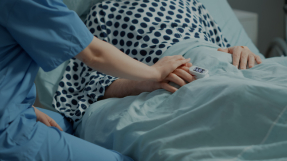
When a distraught mother wept for her child in Ebola-striken Sierra Leone, Scots Army chaplain Rev Chris Kellock did the natural human thing: he put his arm around her to comfort her.
Then he remembered that, although they were in a "clean" area of a British Army hospital, he was not wearing his protective suit.
Kellock, 44, has spoken out for the first time about his tour of duty in Sierra Leone during the Ebola crisis.
He was given just 24 hours' notice before being sent to the West African country for 101 days to support military, medical and other staff as well as relatives of of the sick at the hospital in Kerrytown, 31 miles from the capital Freetown.
Kellock said he was tested to his limits by the experience but described the opportunity for service as a "privilege".
He said: "I'm glad I went and I would do it again. If you read through the history of military chaplains, that is where the essence and heart of what we do is crystallised - supporting spiritually, morally and pastorally the men and women who are at the sharp edge."
Kellock, Church of Scotland chaplain to the First Battalion the Royal Regiment of Fusiliers since July 2014, was deployed to the African nation in September, 2014.
He was responsible for the care of the pastoral and spiritual needs of around 100 staff.
Despite the risks he never really seriously worried about catching Ebola due to the rigorous procedures.
He said: "Ebola is a violent disease, which at that point, was not stopped by any medical intervention.
"In September 2014 there was a real fear that the numbers infected was going to disappear through the roof.
"A family of someone in the unit came in and the mother, who was in the clean area, was distraught.
"So I did what was natural and I put my arm around her and walked with her.
"I was not wearing a protective suit and it was only afterwards that I thought 'crikey I just put my arm round somebody who has a relative with Ebola'."
Patients would spend between 10-12-days in the unit.
The quicker they were admitted for treatment, the better their chance of survival.
Dealing with death on a regular basis was a challenge. Kellock said: "It was quite something when we got the call in the middle of the night when someone had died and we wanted to afford them as much dignity as possible.
"I stayed in a camp about 15 minutes away by bus so a team of three or four of us would go up and prepare the body.
"One of the keys things the Sierra Leone government did was bury the bodies within 24 hours to stop the spread of the disease.
"The reason it spread so quickly is because people would die and the family would invite all their friends round to the funeral.
"People from the village would come and they would kiss the body.
"Ebola is spread through body fluid and even after you clean up, the virus can live outside the body for a certain period of time.
"The virus is at its most potent at the point of death.
"At the height of the crisis for every death, four people were walking away from a funeral infected.
"That was the situation we walked into and we had no idea whether we would end up having queues of people as soon as we opened our doors."
Bodies were kept in isolation and properly disposed of by the Red Cross.
He is sharing his experiences of Sierra Leone at Morningside Parish Church in Edinburgh, which is hosting a series of lectures about chaplaincy throughout September, on Sunday.