Super-rich Armenians have chosen to invest their millions in building churches, but some are questioning the sincerity of the donations.
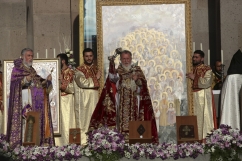
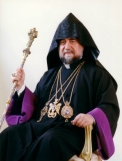
Around 250 churches and monasteries have been built or restored since 1999 in Armenia, according to the office of Catholicos Karekin II, the spiritual leader of the Armenian Church.
Some consider the resurgence in church building is due to the central role Christianity holds in Armenian society; in 301 AD Armenia was the first country to adopt Christianity as its official religion.
Others suggest that in a country where official unemployment rate is 21 per cent, the money would be better spent on infrastructure which would provide more jobs.
Gagik Tsarukian, an Armenian tycoon and founder of one of the country's largest political parties, has paid for work on two churches this year alone. He has helped fund seven churches since 2000, spending tens of millions of dollars.
In Nor Hachn, the site of one of the newly-built churches, Marineh Karapetian complained that "a plant should have been built, rather than a church." Her husband used to work at the town's diamond factory, which is now shut.
She told the Guardian that if it were reopened, "some 500 people would have jobs". "Wouldn't we pray more arduously in that case, and praise Tsarukian with more love and gratitude?"
The country's Prime Minister Hovik Abrahamian, a successful businessman, has also helped fund a church in his south-western constituency Artashat.
Bishop Galstanian, director of the Office on Ecclesiastical Liturgical Issues at Etchmiadzin, holds that these churches are meeting an increasing demand for new churches, while also providing work for Armenian quarries, manual labourers and artists.
Some have suggested the boom in church building is not motivated by devotion, but for financial reasons.
Stepan Danielian, a rights advocate and chairperson of the non-profit Co-operation for Democracy, noted the church does not examine sources of financial donations, suggesting that tax perks might be the true motivator.
Armenia's tax code allows charities to be exempt from work done in building a new church. They also do not have to pay taxes on the purchase of land. The future running costs of the church are met by the Armenian Apostolic Church, which according to the former Prime Minister Hrant Bagratian can run into tens of millions of dollars.
The Gagik Tsarukian Charitable foundation challenged the idea that Tsarukian had ulterior motives, saying the investment "has been done purely out of devotion".