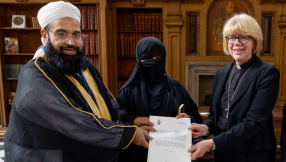
The Archbishop of Canterbury has prayed "in lament for the Church’s involvement in the slave trade" during a tour of West Africa.
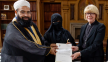
Archbishop Sarah Mullally's tour included a visit to Cape Coast Castle in Ghana, the final departure point for enslaved Africans before they were shipped to the Americas, and a meeting with the King of the Ashanti Kingdom.
"During her tour of the castle, the Archbishop prayed in a former Anglican chapel above the dungeons where male prisoners were kept in appalling conditions. Today it is an educational library and chapel, and stands as a painful symbol of the Church’s involvement in the transatlantic slave trade," Lambeth Palace said.
Commenting on her tour, the Archbishop said, "Being at Cape Coast Castle today and seeing the horrific conditions that thousands of people were kept in, it is impossible not to feel the weight of the immense evil that drove the transatlantic slave trade.
"We have a God who loves each one of us, who created each of us with an individual value and worth, and yet that was not recognised here.
"I pray not only in lament for the Church’s involvement in the slave trade, but also for hope - hope that the God of healing can bring justice and reconciliation to all who are still impacted by its legacy.
"In the name of Jesus Christ, who came to set people free, I pray that we have the courage to continue our journey of repentance, and to strive for a world in which all of God's children are treated with dignity."
The Archbishop also reaffirmed her commitment to Project Spire, a £100m investment fund being set up by the Church of England as a means of reparative justice for historic links to transatlantic slavery.
Officially named the Fund for Healing, Repair and Justice, it was launched in 2023 after research commissioned by the Church concluded that the Queen Anne’s Bounty, a predecessor endowment fund of the Church Commissioners, had links to transatlantic chattel slavery through investments and benefactions.
Last month's meeting of the Church of England General Synod heard that registration of the fund with the Charity Commission has been delayed by legal action from opponents. Synod members were also told that the Church has already spent £1.15m on the project.
The Church of England has faced pushback over the creation of the fund at a time when many parishes are struggling to keep the lights on.
Oxford professor Nigel Biggar has accused African nations of “cynical opportunism” and called them "astonishingly hypocritical" over own complicity in slavery. He has also argued that claims for reparations are based on a distortion of history.
Theologian Ian Paul, writing on his Psephizo blog, was critical of the Archbishop's latest comments in Ghana.
"The irony is, in seeing the splendour of the throne of the King of Ashanti, that the wealth of his kingdom was historically built on slavery," he said.
"The Ashanti Empire ... became one of the wealthiest states in West Africa through a combination of gold, trade, tribute, and slavery.
"Slavery was central to its economy; its largest source of wealth was gold, but the use of slaves in mining that gold, and slavery as trade were vital to its economy."
He went on, "I wonder when leaders in the Church of England will talk about the role we played in eradicating slavery with confidence? ... I find it very odd when church leaders talk of the need for repentance, as if we are the first generation to be horrified by slavery.
"I find it even stranger when they talk of ‘atoning for the sins of the past’ as if we can do that and as if there has not already been massive ‘atoning’ action."
Bijan Omrani, historian and author of God is an Englishman, questioned why Archbishop Mullally was only praying in lament and not praying "in thanks for the work of the clergy, politicians and ordinary people of this country who worked tirelessly to end slavery? For the sacrifices in blood of the British missionaries and sailors who laid down their lives to bring slavery to an end? For acknowledgement and repentance by the elites of your hosts in Ghana about their own deep complicity in the trade?"
Conservative MP, Nick Timothy, said, "Churches in West Suffolk are raising every penny they can to keep the roof up. Many have valuable - sometimes unique - architectural features. They are all part of our national story - our inheritance.
"For Lambeth Palace to pursue gesture politics with such huge sums - while our churches crumble - is grotesque.
"Like Welby before her, the Archbishop is indulging in theologically nonsensical politics. Welby said, 'there can be forgiveness [of those from the past now deemed unacceptable], but only if there’s justice: if we change the way we behave now.'
"Just the same, the Archbishop says 'I pray that we have the courage to continue our journey of repentance.'
"But we cannot repent the sins of others. Forgiveness is not conditional on the behaviour of different people and generations. The Bible says, 'a son will not bear the iniquity of the father, and a father will not bear the iniquity of the son.' This money should be invested in our parish churches."
Gavin Ashenden, a former chaplain to Queen Elizabeth I, said that although slavery was undeniably horrific, the Archbishop was "wrecking the reputation of the only people to do anything about ending slavery".
"William Wilberforce, and his fellow abolitionists, including the group known as the Clapham Sect, achieved the impossible. They ended Britain’s slave trade. With the energetic, valiant and self-sacrificial help of the British Navy, they enforced that abolition on the High Seas," he said.
"The economic cost alone was enormous. The courage required was substantial. The present Archbishop is weeping for a guilt on behalf of people who carried no guilt, and promising money she has no moral right to disburse, that should be used to help shore up the collapse of the ecclesial community she is responsible for."
British military historian Robert Lyman said, "£100m for reparations? At the parish level we are ignored, treated as though we don’t understand the problem. Oh, but we do. We’ve read the reports and can drive a coach and horses through the arguments, and yet it’s as if we don’t exist, or matter. The counter argument that our evangelical ancestors stopped the slave trade is simply ignored, like all uncomfortable truths.
"Who is the church for? The evidence is categorical: it’s not got the local worshipper in the local pew. But be careful, because it won’t be long before we won’t exist at all."
Daniel Hannan, director of the Institute of Economic Affairs, said of the Archbishop's comments, "The Church of England led the world to abolition. It is arguably the single greatest practical Anglican achievement. You can’t find a single word to say about that?"