Roman Catholics and Lutherans are moving closer to the end of centuries of division as the 500th<sup> anniversary of the Reformation approaches.
The two bodies have issued joint guidelines for celebrating the occasion in ecumenical services. Contained in a booklet entitled Common Prayer, they include prayers, suggestions for hymns and themes for sermons.
The guidelines say services should stress thanksgiving, repentance and common commitment, with the main focus on Jesus.
While ecumenical services are common, those envisaged between Catholics and Lutherans have a particular resonance because of the occasion these will celebrate. Martin Luther nailed his famous 95 Theses to the door of the church in Wittenburg on 31 October 1517, taking aim at the abuses rife in the Catholic Church of his day. Among these was the sale of "indulgences", by which people could buy a document assuring them their sins were forgiven.
While Luther began his protest as a movement within the Church aimed at recovering biblical truths that had been denied or obscured, his action was to lead to the splintering of Western Christendom and indirectly to wars of religion that cost hundreds of thousands of lives. Protestant bodies today, including Lutherans, the Church of England, Nonconformists and newer evangelical churches, can all trace their descent from Luther's theological stance.
However, the Churches have been keen to stress the progress made in relations during the last 50 years. One of the most significant moments was the Joint Declaration on the Doctrine of Justification, signed in 1999 in Augsburg between the Catholic Church and the Lutheran World Federation. Justification was at the heart of the conflict between the Reformers and the Catholic Church and reaching a common mind on the issue was a major ecumenical achievement. The Declaration said it could "encompass a consensus on basic truths of the doctrine of justification and shows that the remaining differences in its explication are no longer the occasion for doctrinal condemnations".
More progress was made in 2013 with the production of a 93-page report titled From Conflict to Communion, which laid the foundations for the forthcoming joint celebrations. This includes an outline of the events around Luther's stand and an account of how the divisions between the two communions deepened over the centuries. It says: "We deeply regret the evil things that Catholics and Lutherans have mutually done to each other."
A further report in October 2015, Declaration on the Way: Church, Ministry and Eucharist, identified 32 points on which the Churches had previously disagreed on which they could now speak with a common voice. It refers to a "holy impatience" among Catholics and Lutherans as they "pray and long for clearer and deeper expressions of our unity in Christ".
The Lutheran World Federation, which has conducted the dialogue with the Roman Catholic Church, comprises 145 Churches in the Lutheran tradition and organisational reunification with the Catholic Church would be problematic because each Church would have to agree. However, their theological convergence – which might lead to further agreement in areas such as ministry and eucharist – opens doors in practical and pastoral areas.
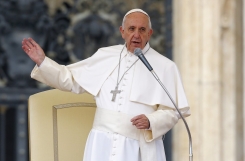
Pope Francis appeared to hint at this last November when he answered a question from a Lutheran woman who asked why she could not take communion with her Catholic husband. He did not explictly give permission, but appeared not to rule it out.