Pope Francis used the 70th anniversary of the bombing of Nagasaki yesterday to call for an end to nuclear weapons.
Speaking to a crowd in St Peter's Square after leading the Angelus prayer, Francis said: "Even after so many years, this tragic event still arouses horror and revulsion."
He added that the bombings of Hiroshima and Nagasaki had "become the symbol of mankind's enormous destructive power when it makes a distorted use of scientific and technical progress and serves as a lasting warning to humanity so that it rejects forever war and bans nuclear weapons and all weapons of mass destruction".
He continued: "Above all, this sad anniversary urges us to pray and strive for peace, to spread brotherhood throughout the world and a climate of peaceful coexistence between peoples. May one cry rise up from every land, 'No' to war and violence and 'Yes' to dialogue and to peace."
He concluded: "With war one always loses. The only way to win a war is never to wage it."
The anniversary of the bombings, which brought the Second World War to an end, has led to soul-searching and renewed calls for nuclear disarmament. Rev Dr Sang Chang, World Council of Church president for Asia, said at the the Nuclear Disarmament Symposium in Hiroshima last week: "Nuclear disarmament now – on the 70th anniversary of the atomic bombings – requires us to focus faith, ethics and morality on the need for an urgent new international law. That law is a legal ban on nuclear weapons, achieved with the widest possible international backing."
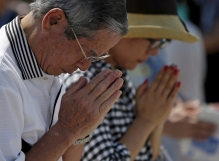
In Nagasaki yesterday, the city's Catholic rebuilt Urakami Cathedral – destroyed in the bombing – drew nearly 2,000 worshippers to a commemorative service. American bishop Oscar Cantu said: "This commemoration calls to mind terrible evil encountered 70 years ago, but as we commemorate in the light of the gospel, this is also an opportunity for us to commit ourselves to peace."
So far nine nations – the United States, Russia, the United Kingdom, France, China, India, Pakistan, Israel and North Korea – have nuclear weapons. There are about 16,300 nuclear warheads in total, though only around 4,000 – mainly American and Russian – are thought to be ready for immediate use.