(CP) Pope Francis is seeking to clarify that the Catholic Church is not changing its teachings about homosexual practices and same-sex relationships as the Vatican faces criticism for approving a document allowing priests to bless same-sex couples.
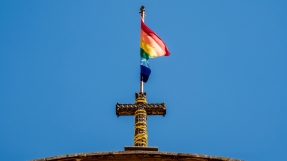
Delivering remarks at the plenary session of the Dicastery for the Doctrine of the Faith Friday, the pontiff addressed the "Fiducia Supplicans" declaration handed down by the Vatican office last month. The declaration, published on Dec. 18, allows priests to bless same-sex couples while stressing that "one should neither provide for nor promote a ritual for the blessings of couples in an irregular situation."
As Francis told the cardinals gathered at the Vatican's Clementine Hall Friday, "The task of the Dicastery for the Doctrine of the Faith is to help the Roman Pontiff and the Bishops to proclaim the Gospel throughout the world by promoting and safeguarding the integrity of Catholic teaching on faith and morals."
"It does this by drawing upon the deposit of faith and seeking an ever deeper understanding of it in the face of new questions," Pope Francis said.
The pontiff elaborated on the reasoning behind the declaration, which received backlash from conservative Catholics who viewed the document as contradictory to church teaching on sexuality. It also received praise from LGBT-affirming Catholics who view it as a "step forward."
"The intention of 'pastoral and spontaneous blessings' is to tangibly demonstrate the closeness of the Lord and of the Church to all those who, finding themselves in various situations, ask for help to continue — sometimes to begin — a journey of faith," said Francis.
"I would like briefly to underline two things," he added. "The first is that these blessings, outside of any liturgical context and form, do not demand moral perfection in order to be received; the second, that when a couple approaches spontaneously to ask for them, one does not bless the union, but simply the people who have required it together. Not the union, but the people, naturally taking into account the context, the sensibilities, and the places where one lives and the most appropriate ways to do it."
Francis' remarks are not the first time the Vatican has sought to clarify the implications of "Fiducia Supplicans."
Cardinal Victor Manuel Fernandez, the prefect for the Dicastery for the Doctrine of the Faith who authored the declaration, released a five-page statement earlier this month insisting that "the document is clear and definitive about marriage and sexuality."
Fernandez stated that a "non-ritualized form of blessing" offered to same-sex couples would last no more than 15 seconds and "does not intend to justify anything that is not morally acceptable." He defined blessings of same-sex couples as merely a "response of a pastor towards two persons who ask for God's help."
Following the publication of "Fiducia Supplicans," some Catholic bishops have explicitly prohibited the blessings of same-sex couples within the dioceses they oversee, including the leader of the Archdiocese of Saint Mary in Astana in Kazakhstan.
Reacting to such actions in his clarification, Fernandez asserted that "there is no room to distance ourselves doctrinally from this declaration or to consider it heretical, contrary to the Tradition of the Church, or blasphemous."
Three days after the declaration was published, Francis criticized what he called "rigid ideological positions" during an annual Christmas gathering at the Vatican.
"Let us remain vigilant against rigid ideological positions that often, under the guise of good intentions, separate us from reality and prevent us from moving forward," he said.
"Fear, rigidity and monotony make for an immobility that has the apparent advantage of not creating problems ... but lead us to wander aimlessly within our labyrinths, to the detriment of the service we are called to offer the Church and the whole world," the pontiff added. "It is important to keep faring forward, to keep searching and growing in our understanding of the truth, overcoming the temptation to stand still and never leave the 'labyrinth' of our fears."