Oxfam have today released their annual report, which says the 62 richest people now have as much wealth as the poorest half of the world's population.
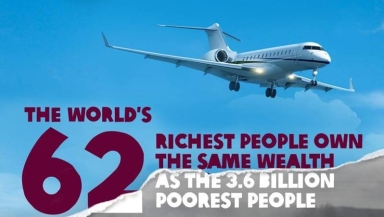
The figures, timed to coincide with the gathering of the super-rich at the World Economic Forum in Davos, Switzerland, reveal that the top one per cent of people own more wealth than the other 99 per cent combined.
Interestingly, the report focuses much more on inequality than poverty. It attacks unequal wealth distribution and in particular calls for the end of tax havens. However a number of think tanks have criticised the use of statistics as "misleading".
"By Oxfam's measure, the poorest people in the world are recent Harvard graduates with student debt piles," said Ben Southwood, head of research at the Adam Smith Institute. "The bottom £2bn don't have zero wealth, but rather about $500bn of negative wealth."
"The poorest person in the world is richer than the next 30 per cent put together," he added. "Having negative wealth may actually be a sign of prosperity, since only people with prospects can secure a loan."
Similarly Mark Littlewood, director general of the Institute of Economic Affairs, said the figures were "bogus".
"The methodology of adding up assets and subtracting debts and then making a global 'net wealth' distribution implies that many of the poorest in the world are those in advanced countries with high debts," he said.
"Whilst we might have sympathy for the Harvard law graduate's plight, it is unclear that worrying about her should be the focus of a development organisation."
But beyond the economics, what does the gospel say about unfairness and inequality?
Jesus was unequivocal in his condemnation of poverty. In fact, in the Kingdom the poor are more than equal to everyone, they are "blessed" (Luke 6:20). Those living in poverty aren't just treated equally to everyone else in Jesus' teaching – they are special. Jesus frequently talks about the "least of these" (Matthew 25:40) and famously teaches "so the last will be first, and the first will be last" (Matthew 20:16).
So Christians must fight firmly against poverty in all its guises if they are to even begin following Christ's teaching.
But, as I said earlier – Oxfam's report places its focus on inequality, rather than poverty. And surprisingly, the gospel is actually remarkably unfair.
The parable of the workers immediately springs to mind. Jesus teaches this as an example of what "the kingdom of heaven is like". A landowner hires workers for his vineyard. But those who only worked half the day, and even those who only worked for an hour, receive the same pay as those who toiled for the whole day.
They "began to grumble at the landowner" but he answered them, "don't I have the right to do what I want with my own money? Or are you envious because I am generous?" (Matthew 20:11,15).
Doesn't this seem remarkably unfair?
When criticised for this unjust method of distribution, Jesus defended the landowner's (God's) right to give more generously to some than others. So I'm not so sure Jesus would sign up to Oxfam's campaign.
But – and there is a very significant "but" here – Jesus had very, very strong words to say about those who had wealth and influence. If he was unequivocal in being on the side of the poor, he was even more unequivocal in the responsibility he said is borne by the rich.
"The servant who knows the master's will and does not get ready or does not do what the master wants will be beaten with many blows," he says in Luke 12. "But the one who does not know and does things deserving punishment will be beaten with few blows. From everyone who has been given much, much will be demanded; and from the one who has been entrusted with much, much more will be asked."
He reserves his harshest words for those who have "been given much", so I think Jesus cares a huge amount about people being poor. And I think he also cares a huge amount about rich people using their influence well. But I don't think he preached against people being wealthy.
Perhaps the gospel has something interesting to come back at the Oxfam report. It is much more about people's attitude to wealth and its uses than wealth itself. It is much more about poverty than inequality.
I am unconvinced by the argument that Jesus preached against the rich. I don't think he did. He preached against those who prioritised wealth over God, and those who didn't use their wealth to help the poor. But I don't think he would have joined Oxfam's rich-bashing campaign. Rather, he would have urged them to use it well for the good of others.