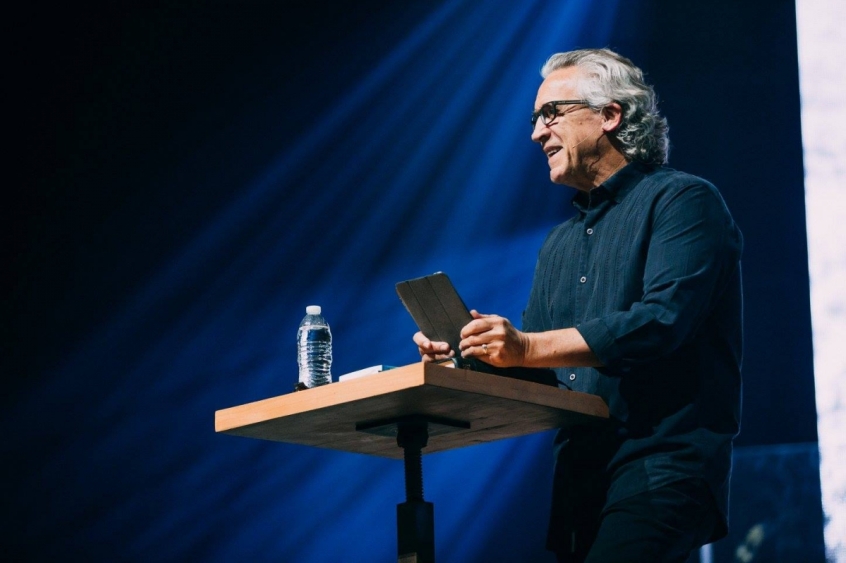
Bethel senior pastor Bill Johnson voted for Donald Trump back in 2016. Now, four years on, with the US facing another election, Johnson is getting ready to cast his vote for Trump once again.
Explaining his decision in The Christian Post, Johnson said the media had falsely portrayed the President as a "racist, misogynist, and xenophobe".
"While everyone is entitled to their own opinions, the facts show that the policies and actions of the President do not fit the characteristics of what those labels imply," he said.
Encouraging people to watch the new documentary, "The Trump I Know", he added: "It sometimes takes a lot of work to find the truth in the midst of a deceptive platform like the evening news.
"Personally, I place more weight on the words of those who have a personal relationship with someone than a portrayal by those with a political agenda."
Johnson said he was impressed with Trump's performance in office over the last four years, claiming that he has "undeniably accomplished — or attempted to accomplish — a majority of his main campaign promises."
"It is an honorable character trait of any elected official to follow through on their commitments," he said.
"As I compare these accomplishments with the nearly half-century voting record of Joe Biden, it is with confidence and a clear conscience that I will be voting for a second term for Donald Trump on November 3, 2020."
But he also revealed how impressed he is by Trump's personal faith, and suggested that his actions on Israel "should appeal to believers".
"For me it is worthy of note that I've never seen a president who loved prayer as much as Donald Trump — and that includes from those I voted for and those I didn't. His passion for godly counsel is also legendary," he said.
He added that it was not his intention to "coerce" anyone into voting for a particular candidate, or to "judge or shame anyone" for their choices at the ballot box, but rather to encourage all Christians to engage thoughtfully and prayerfully with civic life.
His comments differ from another high profile pastor, John Piper, who in recent days has challenged Christians on their support for Trump.
He wrote in a blog on his Desiring God website that he was "baffled that so many Christians consider the sins of unrepentant sexual immorality (porneia), unrepentant boastfulness (alazoneia), unrepentant vulgarity (aischrologia), unrepentant factiousness (dichostasiai), and the like, to be only toxic for our nation, while policies that endorse baby-killing, sex-switching, freedom-limiting, and socialistic overreach are viewed as deadly".
"It is not a small thing to treat lightly a pattern of public behaviors that lead to death," Piper said.
"In fact, I think it is a drastic mistake to think that the deadly influences of a leader come only through his policies and not also through his person.
"Flagrant boastfulness, vulgarity, and factiousness are not only self-incriminating; they are nation-corrupting."