The BBC adaptation of Wolf Hall, Hilary Mantel's Man Booker Prize-winning novel, has won rave reviews from critics – but two Catholic bishops have taken exception to its portrayal of one of the characters.
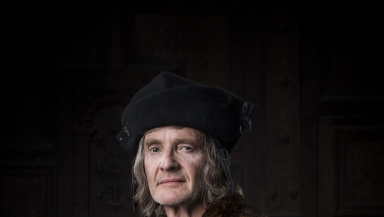
Thomas More, Henry VIII's Lord Chancellor, was beheaded for his opposition to the King's divorce and was later made a saint. However, in the book and the TV series, in which he is played by Anton Lesser, he is shown as a narrow-minded schemer whose opposition to Mantel's hero Thomas Cromwell makes him into one of the villains of the piece.
According to the Catholic Herald, Bishop Mark Davies of Shrewsbury said: "We should remember Wolf Hall is a work of fiction. It is an extraordinary and perverse achievement of Hilary Mantel and BBC Drama to make of Thomas Cromwell a flawed hero and of St Thomas More, one of the greatest Englishmen, a scheming villain.
"It is not necessary to share Thomas More's faith to recognise his heroism – a man of his own time who remains an example of integrity for all times. It would be sad if Thomas Cromwell, who is surely one of the most unscrupulous figures in England's history, was to be held-up as a role model for future generations."
Bishop Mark O'Toole of Plymouth said there was a "strong anti-Catholic thread" in the novels and the TV series. "Hilary Mantel does have this view that being a Catholic is destructive to your humanity," he said. "It is not historically accurate and it is not accurate in what the Catholic faith has to contribute to society and to the common good as a whole.
"There is an anti-Catholic thread there, there is no doubt about it. Wolf Hall is not neutral."
He said that More was "a man of his time", when heresy was seen as "the big sin", but denied that More ever actually condemned anyone to death.
Comparing the fates of Cromwell and More – who were both beheaded – he said: "Thomas More approached his death with serenity and even a degree of humour ... whereas Thomas Cromwell was shouting out loud all night in the Tower and begging for mercy. He saw his death as a deep failure whereas More transcended his."
Mantel's depictions of Cromwell – who was the architect of Henry's break with Rome and the creation of the Church of England – are based on extensive historical research, but – like her depictions of More – have never been presented as true to the historical record. In real life Cromwell was a far less sympathetic character than Mantel describes.
As Lord Chancellor, Thomas More oversaw the torture and burning of heretics and accused the great Bible translator William Tyndale of being "a beast discharging filthy foam of blasphemies out of his brutish beastly mouth".