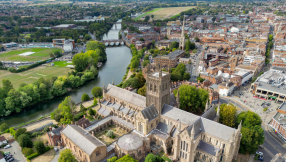
Builders restoring a medieval church next to the official residence of the Archbishop of Canterbury have discovered five 'lost' coffins containing the remains of former Archbishops.
Harry Mount reports for the Telegraph as the first writer to be allowed to view the coffins discovered during the refurbishment of the Garden Museum at St Mary's. The coffins of the five Archbishops, one with a gold and red decorate mitre on top, were among 20 lead coffins found in an ancient, hidden crypt.
The burial chamber was found beneath the chancel by restorers Karl Patten and Craig Dick when they were removing some York stone and dug a small hole in the floor by mistake.
The building works included leveling the floor of the Chancel in order to make the area accessible for a new gallery, the Ark, a recreation of the 17th Century cabinet of curiosities.
To lower the floor level, the contractors were had to lift and re-lay ledgers which had been built into the chancel floor in 1851, some of which weighing up to 1,500kg.
Their removal revealed a concrete block. This was lifted to reveal a flight of steps. 'If you lowered yourself to your belly, a glimpse of an Archbishop's Mitre glittering in the dark. This was the discovery of a recorded vault below the Chancel for high status burials, including those of five Archbishops of Canterbury,' the Museum said.
'This is a discovery of exceptional interest, and will be a new story in the interpretation of the church of St Mary's-at-Lambeth, in which the Museum is housed.'
Nameplates on two of the coffins showed they contained the remains of Richard Bancroft, Archbishop in the early 17th century and John Moore, from the late 18th century.
The remains of 18th century Archbishops Frederick Cornwallis, Matthew Hutton and Thomas Tenison have also been found.
'It was amazing seeing the coffins,' Patten told the Telegraph. 'We've come across lots of bones on this job. But we knew this was different when we saw the Archbishop's crown.'
The find was kept under wraps in the lead up to the museum's reopening in late May.
A glass plate has been installed in the floor to allow visitors to view the coffins, which will be allowed to lie there undisturbed, as they have for centuries.
The expansion and redevelopment of the museum, which began last year, has been part-funded by the Heritage Lottery Fund.
The Lost Archbishops from Garden Museum on Vimeo.
" data-caption="null" data-credit="null">