Sin but no devil: Church of England debates its baptismal liturgy

The Church of England's General Synod has debated the wording of its baptismal services.

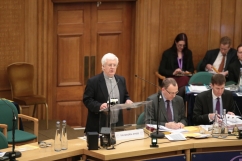
A new baptism service without mention of the devil was debated by members of the Church of England General Synod today

The synod, which sent the texts through to the next stage of the authorisation process, heard that the new texts are needed because the world has changed so much, even in the last 15 years.

Parents are turning up to have children baptised who have lost the language of Church, if they ever had it in the first place.

Bishop of Truro Timothy Thornton said the new baptism texts were being drafted because of concerns that the present services were too "complex and inaccessible" to non-churchgoers.

"Those who work with young people give consistent advice that references to the devil are likely to be misunderstood in today's culture." He said a clear majority of the committee working on the texts had agree it was "unhelpful to refer to a personification of evil in the form of the devil."

In the Church's Common Worship prayer book, the main authorised liturgy in use, the parents and godparents are asked by the vicar: "Do you reject the Devil and all rebellion against God?" They respond: "I reject them."

The vicar then asks: "Do you renounce the deceit and corruption of evil?". They respond: "I renounce them."

He or she then says "Do you repent of the sins that separate us from God and neighbour?" They reply: "I repent of them."

Under the new version, which is an alternative text for people not used to attending church and not a replacement, the questions are simpler and have no mention of the devil.

There are four questions, all with the response: "I do."

The vicar asks: "Do you turn away from sin?", "Do you reject evil?", "Do you turn to Christ as saviour?" and "Do you trust in him as Lord?"


Newsletter Stay up to date with Christian Today
related articles
Islamic State could end Middle Eastern Christianity, Archbishop warns Synod

Islamic State could end Middle Eastern Christianity, Archbishop warns Synod

Archbishop Justin Welby: Evangelism is vital to the Church

Archbishop Justin Welby: Evangelism is vital to the Church

\'Putting our money where our mouth is\': Church of England launches credit union
'Putting our money where our mouth is': Church of England launches credit union

'Putting our money where our mouth is': Church of England launches credit union

Suicides can receive Anglican funerals, says General Synod

Suicides can receive Anglican funerals, says General Synod

News
Who represents you and who do you represent?

Scripture repeatedly shows that God works through representatives, and the spiritual consequences of their actions often extend far beyond their individual lives.

‘Faith covenant’ has strengthened cooperation with local authorities, report finds

A “Faith Covenant” 10 years in the making has played a significant role in strengthening cooperation between faith communities and public authorities across the UK, particularly during times of crisis, an independent evaluation has concluded.

Report warns of continued anti-Christian hostility across Europe during April

There were dozens of anti-Christian incidents across Europe in April, including violent attacks during Easter services, church vandalism, desecrations, arson cases, and assaults on clergy and worshippers.

The Bohemian queen who was a catalyst for the English Reformation

11 May 2026 is the 660th anniversary of the birth of Anne of Bohemia, wife of King Richard II of England, who played an important role in the history of the English Bible. This is the story …