Controversy over a march to mark the anniversary of the conversion of Russia in AD 988 has highlighted the divisions in Ukrainian society following the loss of territory to its giant neighbour.
The event marks the adoption of Christianity in the early Slavic state Kievan Rus.
Both Russia and Ukraine predominantly Eastern Orthodox, but Ukraine has seen a bitter turf war between rival Orthodox Churches which reflects the two nations' political divisions.
The Ukrainian Orthodox Church of the Moscow Patriarchate is loyal to the Russian Orthodox Church of Patriarch Kirill, while the Ukrainian Orthodox Church of the Kiev Patriarchate is identified with Ukrainian nationalism. A third grouping is the Ukrainian Autocephalous Orthodox Church. All emerged from the Russian Orthodox Church in the wake of the Soviet Union's collapse in 1991.
According to a Pew Center study conducted in 2011, around 76.7 percent of the total Ukrainian population – some 30 million people – belong to the Eastern Orthodox churches.
In recent years the Kiev Patriarchate has been steadily growing, from 12 per cent in 2000 to 25 pe rcent in 2016.
Meanwhile, the Moscow Patriarchate fell to 15 per cent during the same period.
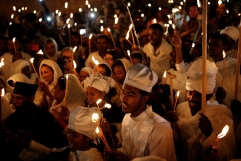
The controversial march was organised by believers from the Moscow Patriarchate and involved two processions, one beginning on July 9 at the Pochayiv Monastery in the western Ternopil region, while the other started at the Sviatohirsk Monastery in the east, near Slovyansk.
The Sviatohirsk Monastery is located in a highly polarised area of Ukraine, less than 100 miles from the pro-Russia separatist stronghold of Donetsk, and rumours that it serves as a Ukrainian outpost for the Federal Security Service (FSB) have heightened suspicions in Ukraine about the purpose of the marches.
However, organisers of the march said its aim was to bring reconciliation and an end to the civil war in eastern Ukraine.
This week, the march was banned from entering Kiev on foot because of security threats, with Ukrainian nationalist protesters shouting that those processing were "agents of Moscow".
Instead, in a compromise those taking part in the march were allowed into the city by bus.
A second march organised by the Kiev Patriarchate took place today and the procession headed for the hillside monument in central Kiev to Saint Volodymyr, the prince who enacted the adoption of Christianity.
Russia and Ukraine share linguistic and cultural ties dating back hundreds of years. But these soured after Russia supported rebel separatists fighting government troops in eastern Ukraine. The conflict has displaced more than a million people since it began in 2014, and displaced some 9,400 people.
In 2014, European diplomats told Reuters that they believed the Russian Orthodox Church was acting as a go-between in eastern Ukraine so that Moscow could continue to deny direct involvement in the conflict.