Afghan President Ashraf Ghani appealed for calm after angry protesters from the ethnic Hazara minority tried to force their way into his Kabul palace on Wednesday to demand justice for seven members of their community beheaded by Islamist militants.
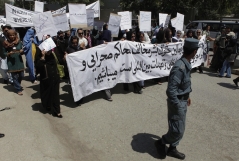
In one of the biggest demonstrations seen in Kabul in years, thousands of people marched through the Afghan capital to demand government action after the killers dumped the partially beheaded bodies of their victims earlier this week.
The murders, which the United Nations denounced as a potential war crime, have fueled a growing sense of insecurity since the Taliban briefly seized control of the key northern city of Kunduz in late September.
Chanting "Death to Ghani, death to Taliban," the demonstrators marched 10 km (six miles) to the palace, bearing the green-draped coffins of the dead and demanding the president come out to face them with a response.
"The only way to prevent such crimes in the future is to take over all government offices until they wake up and make a decision," said Sayed Karim, 40, one of thousands who filled Mazari Square in western Kabul.
In a hastily arranged television address, Ghani, whose unwieldy national unity government has come under growing pressure because of deteriorating security, promised action but called for emotions not to spill over.
"We are committed to avenging our countrymen's blood. We will spare no effort," he said, accusing the militants of stoking regional and ethnic tensions. But he added: "We must avoid reactions that end in anarchy."
At one stage, protesters attempted to scale the walls of a building near the palace, prompting police to fire warning shots to scatter the crowd.
Seven people were wounded, including five from bullet wounds, a spokesman for the public health ministry said.
Sectarian risk
Besides swelling the daily toll of killings, the deaths of the seven Hazara, who included three women and two children, have heightened the risk of sectarian hatred further poisoning relations in a country made up of a patchwork of ethnicities.
The Hazara are a Persian-speaking, mainly Shia minority who have long faced persecution in Afghanistan, with thousands massacred by the Taliban and al Qaeda in the 1990s, but a series of murders and kidnappings this year has stoked a mood of growing despair.
"This sends a very dangerous message to the people of Afghanistan, its government and its international allies," said Abdul Rauf Ibrahimi, speaker of the lower house of parliament. "This issue doesn't belong to a family, a tribe or an ethnic group, but it belongs to all Afghans."
The killings in the southern province of Zabul occurred amid fighting between rival Taliban factions and Islamic State militants that has underlined the risk of further fragmentation and reduced the chances of a resumption to stalled peace talks.
Demonstrators said Hazara people were being killed every day on roads between Ghazni, Bamyan and Wardak provinces to the west of Kabul, where the hardline Islamist Taliban movement controls much of the countryside after international forces stopped most combat operations last year.
Besides blaming the Taliban and Islamic State, some Hazara took to social media to point the finger more generally at Pashtuns, Afghanistan's largest ethnic group from which Islamist movements recruit most of their followers.
"We're from this country," said a demonstrator who gave her name only as Sohaila. "We have to have the same rights as other citizens."