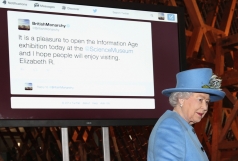
The Queen's high moral authority is down largely to her ability to remain "silent", according to a leading pollster.
Peter Kellner, President of the YouGov polling organisation, told the latest Westminster Faith Debate in London that Britons look mostly to the Royal family for moral leadership. Just one in ten look to religion.
A recent YouGov poll found that more than a third of Britons believe the Queen provides the best moral leadership today. Slightly fewer, three in ten, said it was "William and Kate" who gave the best moral leadership. They had been asked to say which three or four people gave the best moral leadership.
Just 15 per cent chose the Archbishop of Canterbury Justin Welby but even fewer, 8 per cent, chose Prime Minister David Cameron. The Prince of Wales also rated just 8 per cent, alongside Judi Dench and Caroline Lucas. Nobel Prize winner Malala, shot by the Taliban for going to school, pulled in 19 per cent for her strong moral leadership.
The meeting also heard that celebrity activists such as Russell Brand were regarded as moral authorities in modern Brtain.
Mr Kellner told the faith debate that the Queen's authority did not derive mainly from her longevity, although that helped, but from her silence. He suggested Prince Charles might learn from that. He said that personally, as an atheist, he looked to the UN Declaration of Human Rights and the ethical conventions embedded in the declaration.
He also said he would decouple ethics from religious sources of authority.
Professor Linda Woodhead, who chaired the faith debate, said it was "interesting" that women dominated the moral leadership landscape.
Religious commentator Clifford Longley said: "Women are naturally virtuous in a way that men are not." The "conscience" of a family was most likely to be the woman, he added. Longley raised the renewal of Trident as an important moral issue that was not being put before the electorate for debate. He said the job of religion was to "pump virtues into civil society".
Former Home Secretary and Labour Party politician Charles Clarke said many people had stopped listening to the Church because they had lost respect for some of the views being expressed. Referring to the Church of England's controversial pre-election document, he added: "I don't think many people gave a toss about the bishops' letter. I think the reason is the Church has lost a lot of authority to be able to talk on these moral questions."
Eliza Filby, author of the recent book God and Mrs Thatcher, said the work the Church does in communities is a success story but it was a challenge for the Church to make its voice heard.