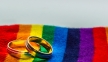
A judge has rejected two cases challenging Northern Ireland's ban on same-sex marriage, saying it is up to politicians not the courts to decide social policy.
The High Court dismissed a joint case taken by the first lesbian couple and the first gay couple to enter civil partnerships in the UK as well as a second from a couple who married in England but wanted their partnership recognised at home in Northern Ireland.
Delivering his ruling, Mr Justice O'Hara said: 'It is not at all difficult to understand how gay men and lesbians who have suffered discrimination, rejection and exclusion feel so strongly about the maintenance in Northern Ireland of the barrier to same sex marriage.
'However, the judgment which I have to reach is not based on social policy but on the law.'
The Christian Institute's Northern Ireland director, Callum Webster, said he was 'greatly encouraged that the law on marriage has been upheld'.
He added: 'This attempt to redefine marriage through the courts has not been successful. The definition of marriage as between one man and one woman is beneficial for all society, and it is excellent news that it has not been changed by this ruling.'
Northern Ireland is the only part of the UK not to legalise same-sex marriage, despite becoming the first to legalise civil partnerships 12 years ago.
Assembly members have now voted five times on whether to allow gay marriage. At the fifth vote they voted in favour for the first time by 53 to 52 but the Democratic Unionist Party (DUP) used their Stormont veto to block the move.
Ms Sickles and Ms Close made history when they became the UK's first civilly partnered couple in Belfast City Hall in December 2005. They were closely followed by Chris and Henry Flanagan-Kane, whose ceremony took place a day later.
The two couples are now leading the campaign for full marriage recognition, arguing the ban doesn't respect private and family life and so breaches article eight of the European Convention of Human Rights.
Close said she was 'devastated' by the ruling, according to the BBC.
'For us, this is a personal matter,' she said.
'We have families and our children are being treated differently because of today's result.'