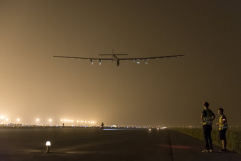
Will human beings be able to board planes that can fly faster than the speed of sound, but with less impact on the environment? The National Aeronautics and Space Administration (NASA) is taking a step towards this direction, and it involves millions of dollars.
The space agency recently announced that it is allotting $6 million to fund research to develop a more environmentally friendly supersonic aircraft, which can dramatically cut flight times for passengers.
The Massachusetts Institute of Technology (MIT) is one of the biggest recipients of NASA's funding to develop the new generation of planes. The university's study will particularly explore how previous supersonic aircraft developed by NASA can cause less environmental damage.
At present, supersonic flights burn more fuel and travel closer to the stratosphere than other traditional aircraft, giving them more potential to damage the ozone layer, which protects the Earth from the sun's harmful ultraviolet rays.
Another main recipient of NASA funding is the Wyle Laboratories, a research contractor based in Virginia. It will particularly research how turbulence affects sonic booms.
Aside from research on emissions and turbulence, NASA also allocated a big chunk of the funds into discovering ways on how to make supersonic flights a lot quieter.
When the last supersonic flight called the Concorde was launched in 2003, the plane broke the sound barrier and created a sonic boom, causing sounds so loud that fire alarms were set off.
Another area of research being prioritized by NASA is making supersonic flights more commercially viable by accommodating more people. The Concorde caused running cost issues when it was launched by Air France in 2003.
With all these researches, the NASA hopes it can start production of the first business-jet-sized supersonic planes in 2025, and commercial planes by 2030.