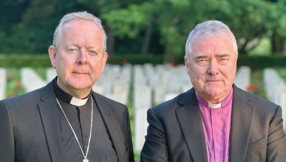
The Archbishop of Canterbury is facing a mass call to overhaul the Church of England's approach to sex abuse survivors after his letter to one victim was branded 'painful' and 'disappointing'.
'Gilo', a survivor of clerical sex abuse whose surname is withheld to protect his identity, wrote an open letter to Justin Welby urging him to abandon the Church's insurer, Ecclesiastical Insurance Group (EIG), in the wake of a controversy over its treatment of victims.
Welby replied last month and said the 'complex issues' Gilo raised were being addressed through a mediation process and said the question of mandatory reporting of abuse, which Gilo called for, was a 'complicated question' and 'not as straightforward an issue as is sometimes suggested'.
But in a longstanding row over how seriously the Church takes allegations of abuse, Gilo said the archbishop's response failed to answer the questions he raised.
'There doesn't seem any ownership of the crisis, nor recognition that questions such as these need facing at "archbishop level" and the clear call of leadership required to shift the Church into structural and cultural change and towards authentic justice,' he said. 'Until the Church buckles under the weight of these things – the shilly-shallying will continue.'
But a legal expert consulted by Christian Today said: 'On the assumption that the issue might possibly give rise to legal action against the CofE, anything that any senior bishop says on the matter – let alone the Archbishop of Canterbury – must inevitably be guarded so as to avoid any premature admission of liability.
'The Church's lawyers would have been totally failing in their duty to their client had they not pointed that out and, in the circumstances, it's difficult to see what else anyone could have done.'
However, now more than 20 senior figures involved in dealing with clerical abuse, including a current bishop, have joined Gilo in a widespread call for change.
The Bishop of Buckingham, Alan Wilson, who has been involved in the mediation process with survivors, said Welby's letter 'strikes a sincere, kind and conciliatory note' but added: 'I'm an optimist, but have to say I think the letter was a sign of progress, but also how far we have to go to make the Church a safe place for vulnerable people, and to avoid the effects of disclosure being compounded by the Church's institutional response.'
April Alexander, a senior member of the Church's general synod and Christina Rees, a founding member of the Archbishops' Council, are among the signatories with Alexander saying 'reasonable' financial settlements for survivors was 'simply the right thing to do' and Rees saying the Church needed to re-examine the structures that marginalise and demean those who have suffered abuse.
Baroness Walmsley, a peer in the House of Lords who has worked on mandatory reporting of abuse, was one of those who joined the call for change.
'My view about mandatory reporting is that it is a very simple matter, not complex at all,' she said in response to Welby's letter, which Gilo made public. 'If you know or suspect that a child is being abused, or has been abused, you must report the matter to the correct authorities. To fail to do so is to collude with the perpetrator. End of!'
Richard Scorer, a solicitor specialising in abuse cases, said 'the Archbishop could do much better'.
He said: 'He should use his position and wider influence to insist on real change in two key respects. First, mandatory reporting, so that those who might otherwise be tempted to collude in the cover up of abuse know that they have no option but to report it. Second, fair and just reparation for survivors, as part of a wider restorative process, so that the true extent of the harm caused by abuse is properly acknowledged. Given the extent of the abuse scandal now revealed in the CofE, the Archbishop owes survivors nothing less.'
Andrew Graystone, a broadcaster and theologian, said Welby's letter was 'painful to read and he is clearly caught in an impossible dilemma'.
He said: 'This dilemma between institutions and individuals is addressed repeatedly in the gospels. In every case, Jesus makes clear that people take priority over religious institutions. It would be a powerfully prophetic act if Archbishop Welby could use the authority of his office to face down the principalities and powers of his institution, and put victims first.'
A spokesperson for the National Safeguarding Team said: 'Archbishop Justin wrote a personal letter to Gilo as part of a mediation process about his case which was also the subject of an independent review in 2016.
'The archbishop, who believes the safeguarding of children and vulnerable adults should be the highest priority of all parts of the Church, apologised for the ways in which Gilo had been treated by the Church, and by Lambeth Palace in particular, in the past. A joint statement from all those involved in the mediation agreed it was not an easy process, but that it was a helpful and productive one for all concerned.'
You can read all the responses here.