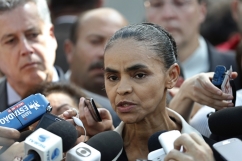
While one presidential candidate has made headlines with his homophobic slurs, the gap between President Dilma Rousseff and her closest rival, Marina Silva, a committed Christian, has widened, according to the most recent polls.
Polling results released yesterday by Vox Populi gave the President a seven-point lead. The results from another polling company, MDA, put Rousseff nine points ahead, increasing the gap significantly from the one point lead she had in their poll a week earlier.
The first round of the election takes place on October 5, when Rousseff is expected to win the most votes. But since none of the candidates is likely to get more than a 50 per cent of the votes, a second round is expected to take place October 26, when it will be between the two candidates with the most votes in the first round.
Foreign investors had high hopes for Silva, the Socialist Party candidate and former environment minister, who, as well as having an unusual personal story, has been willing to embrace market principles. If Silva comes second in Sunday's election, as is anticipated, she may well do better in the second round, as she will receive equal campaign coverage to her rival. At the moment Silva has about 80 per cent less funding and airtime for her campaign.
Silva came late to the campaign, as she replaced her party's original candidate, Eduardo Campos, who died in a plane crash on August 13. She told reporters it was an act of "divine providence" that prevented her being on the same flight.
At the time of Campos' death he was third in the polls, behind Aécio Neves of the Social Democratic Party, who has now moved into third position.
Silva grew up in the Amazon rainforest, one of 11 children born to rubber tappers. As a teenager she suffered from hepatitis and malaria, and was taken in by Catholic nuns who nursed her back to health and taught her to read. At the convent she was taught to read and was also introduced to liberation theology – a reading of scripture which prioritises the needs of the poor.
After working as a domestic maid, she became a teacher and environmentalist. Then at 36, she became Brazil's youngest senator ever, as well as being the first rubber tapper elected to the Senate.
Levy Fidelex, one of four fringe candidates with little hope of electoral success, further damaged his chances in a televised debate on Sunday when he said that homosexuals "need psychological care" and were better kept "well away from [the rest of] us".
Among the other fringe candidates is televangelist and pastor, Everaldo Pereira, representing the small evangelical party PSC. As an Assemblies of God pastor he is vying for the same evangelical support as Silva. Again, this could work in Silva's favour if she goes through to the second round with Rousseff. In that case the 20-25 per cent of the population that are evangelicals, would be more likely to support Silva.
For Brazil's largely Catholic population, faith plays a significant role in politics. President Rousseff struggled to gain the support of faith voters at the last election, despite her Catholic background. Silva appeals to both the progressive left and conservative right on some issues, though she is by no means guaranteed support from Christians.