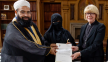
Pope Francis, the Archbishop of Canterbury and the Moderator of the Church of Scotland General Assembly have condemned the criminalisation of homosexuality at the end of their historic peace pilgrimage to South Sudan.
During a press conference on the return flight, the Pope said it was a "sin" and "injustice" to criminalise homosexuals, and that they "should not be marginalised".
He was asked to elaborate on his comments in an Associated Press interview last month in which he said that homosexuality was a sin but "not a crime".
Speaking to reporters on the flight home from South Sudan yesterday, the Pope said that the criminalisation of homosexuality, with the death penalty in some places, is "an issue that must not be allowed to pass by".
"This is not right. People with homosexual tendencies are children of God, God loves them, God accompanies them," he said.
"It is true that some are in this state because of various unwanted situations, but to condemn such people is a sin; to criminalize people with homosexual tendencies is an injustice."
Archbishop Justin Welby and Moderator, Dr Iain Greenshields, also joined the press conference onboard the flight.
The Archbishop echoed the Pope's comments and referred to a debate taking place in the Church of England General Synod this week about controversial plans to permit blessings for same-sex couples.
"It may not have entirely escaped your notice that, in the Church of England, we've been talking about this 'just a little' recently, including a good deal of debate in Parliament and all kinds of things," he said.
"I want to say I wish I had spoken as eloquently and clearly as the Pope. I entirely agree with every word he said there."
The Archbishop said that the Church of England and Anglican Communion had passed resolutions condemning the criminalisation of homosexuality but that "it has not really changed many people's mind".
He continued, "Over the next four days in the General Synod of the Church of England, this is our main topic of discussion, and I shall certainly quote the Holy Father. He said it beautifully and accurately."
Rev Greenshields added, "There is nowhere in my reading of the four Gospels where I see Jesus turning anyone away. There is nowhere in the four Gospels where I see anything other than Jesus expressing love to whoever he meets.
"And as Christians, that's the only expression that we can possibly give to any human being in any circumstances."