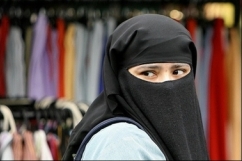
Prime Minister David Cameron's remarks about Muslim women wearing full-face veils or niqabs have reignited issues of how religious conservatives integrate into wider British society. But what did he actually say, and how should we understand the issues?
I heard something about 'British values' again...
We will come to British values in a moment. But Mr Cameron said there were times when wearing the niqab was inappropriate and Muslim women would have to respect that. He gave the examples of court appearances, border controls and school uniforms.
So no blanket ban?
He specifically denied it, though some newspaper headlines today have suggested otherwise. We are not in France, where women have been banned from wearing the niqab since 2010.
That seems quite reasonable. It's a free country, after all.
Quite. Britain does not prescribe dress codes, though there are sometimes restrictions on wearing things in particular places. Some shopping centres and other areas have banned people wearing hoodies because they're associated with anti-social behaviour, for example.
I bought a rather nice one at Greenbelt.
Stay out of Sefton in Merseyside, then; it's clamping down on people like you. The comparison between niqabs and hoodies has something going for it, though. For some people, wearing a niqab is a sign that someone doesn't really fit into British society and might be a bit radical.
Sorry, are we still talking about Greenbelt?
Forget about Greenbelt. The PM's comments were in relation to Muslim women from conservative backgrounds who don't learn English and who don't leave the house without a male relative. He actually said some "are not allowed out of the house".
That's terrible.
But not very nuanced. The point is that he, like most other middle-class liberals, seems to have bought into the idea that women wear the niqab and stay at home because they are oppressed by the male members of their families, when what they'd really like to be doing is hitting nightclubs and dancing round their handbags.
The handbag thing aside, aren't Muslim women a bit oppressed?
We need to be careful about using "Muslim" too loosely. Not all Muslim cultures mandate men to exercise extreme control over women and most don't insist on the niqab. However, many immigrants from particular parts of Pakistan, for instance, import cultural assumptions about the place of women which are wildly divergent from our own, sometimes with tragic consequences like so-called "honour killings".
Back to the nightclub thing, though?
Some people argue that the niqab, and the all-enveloping burqa, are intrinsically patriarchal and oppressive. There is a strong argument for that, but it's also necessary to acknowledge that this isn't necessarily how they are seen by the women who wear them. They might resent it, but on the other hand they might freely choose this way of life as a manifestation of religious devotion and family solidarity. So no, they don't all want to join the happy hordes dancing around to the latest hits in Tiger Tiger.
I don't either.
One Direction aren't for everyone. But the point is that freedom of religion is freedom for all religions, not just ours. It can't be unconditional, but we should be very, very slow to infringe upon it in the name of community cohesion or national security. Things that look odd to the majority culture are very, very important to minorities and we should respect that. The PM is right to worry about people not integrating into British life, but there are different ways of doing that and we shouldn't expect everyone to behave like everyone else. There's nothing intrinsically un-British about wearing a niqab if that's what you choose to do. It's only un-British if someone makes you do it – or, indeed, stops you doing it.