
The Archbishop of Canterbury has urged Christians to approach inter-faith dialogue with confidence in their own beliefs about the uniqueness of Christ whilst retaining a desire to learn from others.
In an address exploring the finality of Christ in a pluralist world on Tuesday, Dr Rowan Williams said people who believed in absolute truth were liable to be branded bigots or intolerant by those who felt that what was right for some was not necessarily right for others.
“Belief in the uniqueness or finality of Christ is something that sits very badly indeed, not just with a plural society but with a society that regards itself as liberal or democratic,” he said.
“This is a world where the ideal is simply to be presented with the choice that makes you comfortable and the question of truth or finality isn’t really allowed to arise.”
The Archbishop admitted that accepting the uniqueness of Christ was “problematic” for many people and that Christians faced the challenge of communicating what they believe.
He added, however, that giving up on the uniqueness of Christ was not “sensible”.
“Christians have claimed and will still claim that when you realise God calls you simply as a human being into that relationship of intimacy with Jesus, then you understand something about God which cannot be replaced or supplemented,” he said.
“The finality lies in the recognition that now there is something you cannot forget about God and humanity and which you cannot correct as if it were simply an interesting theory about God and humanity.”
The Archbishop said that affirming the uniqueness and finality of Christ, rather than being unfair to those who had not heard of Him, made possible the universal reconcilability and fellowship of human beings.
He warned that there was a danger of “treating others as if they know nothing, and we have nothing to learn” if Christians simply believed there was no hope for people outside of the Christian faith.
A belief in the uniqueness and finality of Christ, he said, gave Christians a “generous desire to share” and a “humble desire to learn”.
“In dialogue between people of different faith we expect to learn something, we expect to be different as a result of the encounter. We don’t as a rule expect to change our minds,” he said.
“We come with conviction, with gratitude and with confidence, but it is the confidence which I believe allows us to embark on these encounters, hoping that we may learn - not change our conviction - but learn.
“When we sit alongside the Jew, the Buddhist, the Muslim, the Hindu, we expect to see in their humanity something that challenges and enlarges ours. We expect to receive something in their humanity as a gift to ours.”
In an evening event with broadcaster and Surrey University professor Jim Al-Khalili, the Archbishop urged people not to be overwhelmed by the scale of challenges like poverty and climate change, but instead realise the impact of individual decisions and actions.



-

UN officials demand explanation for Iranian church seizure
-

AI could become a ‘very dangerous master’, warns John Lennox
-

Calls for Church of England to be 'rooted in scripture' ahead of General Synod elections
-

When Eastern Europe appeared to be going Protestant
-

Archbishop of Canterbury withdraws award given to Muslim cleric who praised Bin Laden
-

Most practising Christians are evangelical, study finds
Most Popular
News
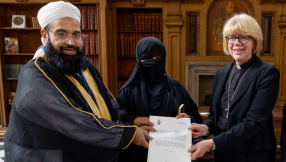
Archbishop of Canterbury withdraws award given to Muslim cleric who praised Bin Laden
Reform leader Nigel Farage said the decision to award Hafiz Muhammad Tahir Mehmood Ashrafi was "astonishing".
How the new General Synod could move beyond the present disagreement over same-sex relationships
How might the next Synod make progress in the next five years based on a recognition that there are those in the Church of England who hold fundamentally opposed positions on the matter? Is there a way of allowing both sides to achieve what they want? Martin Davie argues that the answer to this question is ‘Yes.’
No part of London should become a free speech, gospel exclusion zone
Soho is not exempt from freedom of speech and Christian expression. And Christians do not lose their fundamental freedoms when they cross an invisible boundary into a neighbourhood associated with a different worldview. The streets of London belong to all of us, writes Andrea Williams.
Church of England blessing same-sex relationships 'a bridge too far'
Earlier this year the Church silenced a group of former-homosexuals who wanted to tell of the change in their lives.








