The report by Oxford University's LGBTQ+ Society on the city's churches does not augur well for the future of freedom of religion or belief in Britain.
The Attitudes Towards Queer Christians in Oxford Churches report by the Society's Safe Churches Team declares: "The dark shadow of the 'Traditional View on Marriage' has to be acknowledged as the demonization, pathologizing, and stigmatising of all LGBTQIA+ people. From our perspective, this stance is rooted in inaccurate and harmful theology, translation, interpretation, and understanding of scripture."
The 11-strong team of student commissars behind the report, published as the university begins a new academic year, used a traffic light system to categorise around 30 churches "with 1 being the least inclusive of LGBTQ+ people, and 5 being the most inclusive". Churches scoring 1 and 2 are branded red, 3 amber, and 4 and 5 green.
According to its website, the Society "is the largest higher education LGBTQ+ Society in the country, and with over 3000 members, the second largest society of its kind at the university". Oxford University has around 26,000 students, including undergraduates and post-graduates.
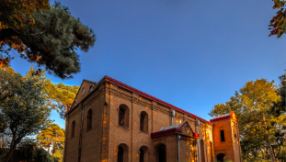
St Ebbe's in Oxford city centre, a large Anglican evangelical church attended by many university students, was among several churches that got the lowest 'red' rating.
In a news story on the report The Church Times included a statement from the Rector of St Ebbe's, Canon Vaughan Roberts.
The section on St Ebbe's had cited an anonymous "openly queer" person, who described being "left on the periphery" and feeling "very alone". Another person had spoken of being made to feel "very unsafe" when asked to explain why they wanted to leave the church, and claimed that they were "effectively threatened with hell".
Canon Roberts told the paper that he was "very sorry to hear of anyone who has not had a positive experience of St Ebbe's".
"We welcome a very wide range of people, including those who would identify as LGBT or same-sex attracted. It would never be appropriate in a pastoral setting to threaten anyone with hell."
He added: "We do affirm a traditional Christian ethic in relation to sex and gender, but we seek to be very careful indeed in how this is applied pastorally."
Other churches denounced in the report include St Aldate's, a large evangelical charismatic church also in the Church of England. The commissars declare: "St Aldates, and particularly its leadership, has a history of campaigning against LGBTQ+ relationships and identities ... Church leadership are unlikely to affirm LGBTQ+ people and may expect them to live celibate lives."
The Christian Life Centre on Oxford's Cowley Road and Magdalen Road Church were among a number of churches that received the lowest rating, as did the university's evangelical Christian Union.
The commissars slammed Magdalen Road Church, part of the Federation of Independent Evangelical Churches (FIEC), for being "affiliated with the Evangelical Alliance who 'oppose moves within certain churches to accept and/or endorse sexually active same-sex partnerships as a legitimate form of Christian relationship', and reject anyone in these relationships from leadership".
The commissars rated Hope Vineyard Church a little better, giving it a 2, but denounced it for possibly holding hidden views: "Hope Vineyard Church is connected to the Vineyard Church Network, which is a part of the Evangelical Alliance. This suggests that there may be some opposition to LGBTQ+ relationships, or a 'love the sinner, hate the sin' approach in the Church.
"There are a few resources that suggest they want their church to be inclusive, but it is unclear whether this is just in terms of race and ethnicity. Overwhelmingly, Hope Vineyard is silent on issues of sexuality in direct teaching, but possibly holds hidden views opposing same-sex relationships, so is rated at a 2."
The University Church of St Mary the Virgin on the city's High Street is among those with the highest rating: "LGBTQ+ identities and relationships are affirmed and welcomed into the discourse at University Church. A space is actively created for LGBTQ+ Christians every year in the Pride Service and same-sex relationships are celebrated through marriage ceremonies."
From an elite university like Oxford, today's student commissars could easily become tomorrow's political leaders. Unfortunately, both the denunciations and the commendations here are such that if the UK were to turn into a neo-Marxist elective dictatorship, one could imagine a report like this being cited in a show trial against members of biblically orthodox churches.
Julian Mann is a former Church of England vicar, now an evangelical journalist based in Lancashire.