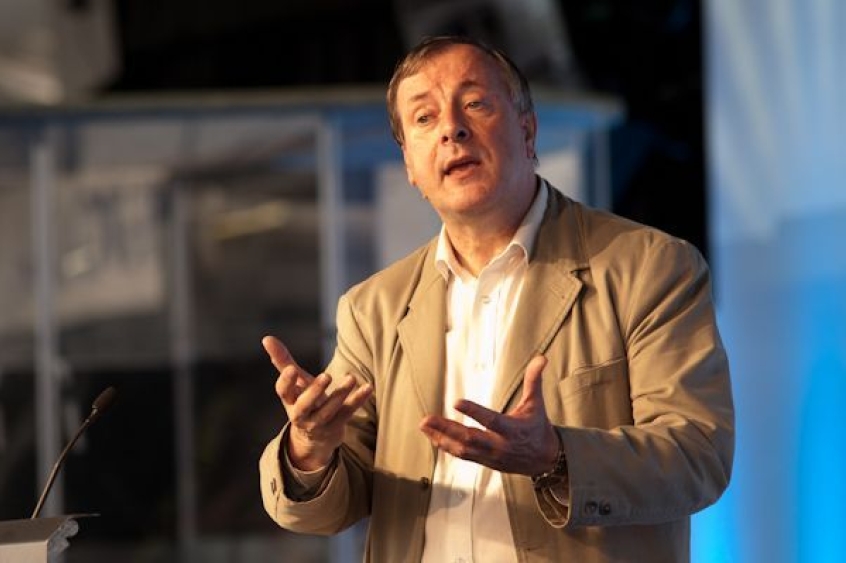
Theologian and apologist Alister McGrath once thought that reason was a stumbling block to faith. But now the former atheist says human reason is limited, and cannot fully grasp the reality of God.
He was addressing more than 3,000 Christians at this year's Keswick Convention, meeting in the Lake District.
Professor McGrath encouraged the Christians gathered to be bold in proclaiming the Trinity, saying that it gave people a framework for understanding God.
"The Trinity is a way of safeguarding our vision of God… making sure we never sell God short to ourselves or anyone else. In this challenging context in which to present God, we need to present God in all his fullness," he said.
"The doctrine of the Trinity is this realisation that God is just so great, we are never going to fully able to make sense of him, even though we can trust him."
Professor McGrath, head of the Centre for Theology, Religion and Culture at King's College London, was the first guest speaker to address this year's convention.
He insisted that the Trinity and the Christian faith were not "irrational" and that believers need not be afraid of atheists and other critics.
"I [once] thought, this doctrine is just clearly bad mathematics, it's just nonsense. You can only trust what reason can prove. That seemed to me at the time to be a good argument against the doctrine of the Trinity. But, we need to realise there are limits to what reason can take in," he said.
"Sometimes things are so big and bright and luminous that we can't take them in. Richard Dawkins limits reality to what we can prove. That is a terribly small and very uninteresting world. You can prove that two and two make four, but that doesn't give you a reason to get up in the morning, to live and to hope.
"Atheism presents us with a narrow little world."
He said one of the reasons atheists were so critical of Christians was because it detracted from having to look at their world and "realise how little it is".
The Christian faith, he argued, makes sense "of itself" when it is experienced "within us" and in what can be seen around us.
"Christianity doesn't go beyond reason, but recognises there are limits to reason. It opens up this great and bold picture of what things are really like. The fact that we have difficulty in taking something in doesn't mean it is irrational, it just means our little minds find it very difficult to take in big things."
He continued: "It goes beyond what we as human beings can master and understand. Atheism is simply a human philosophy. It says, what we can understand – that's it. What you see is what you get. Christianity is saying: what you see is great, but it makes even more sense when you see the bigger picture and realise that what we can understand is only part of something bigger, but what we can see now is good enough to be going on with."
The Keswick Convention has been meeting in the Lake District since 1875. This year's convention got underway on Saturday and will continue until 2 August, during which time an estimated 12,000 to 15,000 people will attend.
Other speakers include mathematician Professor John Lennox from the Oxford Centre of Christian Apologetics and CARE's executive chairman Lyndon Bowring in the third week.