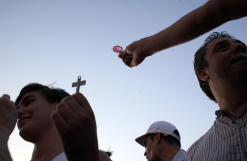
Fewer Americans are now "absolutely certain" that God exists, the Pew Research centre has found, despite religion remaining high on the agenda in the run up to the 2016 presidential election.
Overall, the American public is becoming less religious – but only slightly. Pew's Religious Landscape Study last year found that 3.1 per cent of American adults consider themselves atheists; an increase from 1.6 per cent in 2007.
In light of these statistics, Pew has put together a number of facts about atheism in the US. Here's what they've found:
1. Some atheists actually believe in God. Two per-cent of adults in the US who identify as atheists also say they are absolutely certain in their belief that there is a God or a universal spirit, while a further 3 per cent say they are fairly certain. Only 92 per cent are certain that they don't believe in some kind of God.
2. Most atheists lean to the left politically. Nearly 30 per cent of Democrats say they have no religion, and religious 'nones' are now the single largest religious category in the Democratic coalition. Over two-thirds (69 per cent) of self-identified atheists identify with or lean towards the Democratic party.
3. The majority of atheists are young men. The median age of US atheists is 34, while four in ten are between the ages of 18 and 29 and only 9 per cent are above the age of 65. Men comprise over two thirds (68 per cent) of all atheists, compared to 45 per cent of all Christians.
4. Atheists marvel at the universe more than Christians. According to Pew, 54 per cent of self-identified atheists say they often feel a sense of wonder about the universe, compared to just 45 per cent of Christians, perhaps indicating that though the public may be becoming less religious, it is still spiritual.
5. The majority of atheists turn to common sense for guidance. Rather than religion or philosophy, unsurprisingly most atheists (44 per cent) say they turn to common sense for guidance on questions of right and wrong. Science comes a close second, at 32 per cent. Interestingly, the same percentage of Christians (41 per cent) turn to religion as turn to common sense.
6. A number of atheists still go to church. One per cent of atheists attend church weekly, and one in ten go at least once a year. Of those who identified as Christians, 17 per cent never attend church, while just 45 per cent attend weekly or more often. One per cent of atheists say they pray daily or more often, compared to two thirds (68 per cent) of Christians.