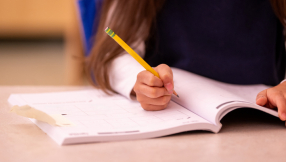
Poverty is holding children back from taking certain subjects due to the associated costs, a charity has warned.
The Child Poverty Action Group (CPAG) said that nearly a quarter of secondary school students on free school meals have avoided taking certain subjects at GCSE level due to concerns around costs.
In addition to regular school expenses, such as uniforms and stationery, some subjects at GCSE level come with additional costs, for example fieldwork trips for geography, exchange trips in foreign languages, musical instruments, or sports equipment in PE. The costs involved vary from school to school.
A survey of over 1,000 secondary school children in England found that 23 per cent of children on free school meals had chosen not to study a subject because of the additional costs. Even apparently better off students have been impacted, with nine per cent of students not on free school meals saying the same thing.
Over a quarter (29 per cent) of student on free school meals said cost was an important factor when choosing a subject, compared to 11 per cent of those not receiving free school meals. Almost a third of students eligible for free school meals (30 per cent) said that even the cost of doing their regular homework, for example when technology or devices are required, was difficult to meet.
Some churches are doing what they can to alleviate the costs of sending a child to school.
Ely Cathedral ran a “school uniform community wardrobe” this summer that was stocked with donated school clothes for children attending local primary schools. Parents were allowed to take what they needed free of charge or give a donation if they were able to.
The Salvation Army in Hednesford ran a similar scheme called Plum - the Pre-Loved Uniform Market.
CPAG called upon the government to do more to reduce child poverty, specifically calling for an end to the two-child benefits cap.
Kate Anstey, Head of Education Policy at CPAG, is calling on the government to scrap the two-child limit on , “Children in struggling families are going back to school only to be bounced out of some subjects and learning by costs – cut off from opportunities just as the foundations of their futures are being laid.
“The Prime Minister has promised to leave ‘no stone unturned to give every child the very best start at life’ but actions are needed to match that objective.
"[The] Government‘s forthcoming child poverty strategy must invest in family incomes and children’s life chances - and scrapping the two-child limit must be the first action point.”