
A Palestinian Christian leader is cautiously optimistic about this week's Israeli-Palestinian peace talk agreement, commenting that the leaders now need to "walk the talk".
"So far it's just a signature; now they have to walk the talk," said Munib Younan, the Bishop of the Evangelical Lutheran Church in Jordan and the Holy Land, according to the World Council of Churches.
He added, "I do hope this is a serious attempt to achieve a lasting peace."
President Bush announced Tuesday after a full day of meetings with Israeli, Palestinian and international leaders that Israel and the Palestinian Authority leaders have agreed to negotiate a peace treaty to establish a Palestinian state.
The two sides set the goal to complete the treaty by the end of 2008 - before Bush leaves office.
However, the parties remain skeptical about the Israeli-Palestinian statement, expressing that what happens in the next few days and months is much more crucial than the statement itself.
"The document is as bland as people predicted it would be," noted a member of the Palestinian delegation, who asked not to be named because he was not authorised to speak.
"Success or failure will happen in the next couple of months," the delegate told CNN.
Bishop Younan echoed the sentiments of the Palestinian delegate, noting that "[e]xperience has taught us that words and talks must be accompanied by tangible, visible changes on the ground."
Younan is a member of the Palestine Israel Ecumenical Forum - a new World Council of Churches initiative launched to increase advocacy for peace with justice in the region.
After meeting with the leaders of Israel and the Palestinian territories, President Bush said Wednesday that peaceful results can only occur if Palestine and Israel share the common vision for peace and find common ground.
"We (the United States) can't dictate the results," Bush said on CNN.
It "is not realistic" to think that the United States can impose a vision of peace in the Middle East, he added.
"It's got to be a Palestinian vision and an Israeli vision where they find common ground."
Meanwhile, according to Younan, the role of Mideast churches in the peace process is "to continue being prophetic".
"We are not politicians; our role is to seek justice. If justice is not achieved, extremism will thrive," said the Palestinian Christian leader. "And we should not allow the extremism to take hostage Palestine and the whole Middle East. This is the time for justice and we need to seize it."
-

Christian advent calendar sales 'soar' after online storm with Meghan Markle fans
-

Immigration fears shape views of Britishness and Christianity, report finds
-

Christian teacher challenges dismissal after sharing pro-life views in class
-

US evangelicals more religious than other Christians, but still declining
News
-
Televangelist Jim Bakker dies at 86
-
Blackburn Cathedral puts the Bible where it belongs
-

When ‘my truth’ replaces the truth
-

The book that changed Sweden: 500 years of the Swedish New Testament
-

UK Christians unite for nine days of prayer as National Week of Prayer enters third year
-
Christian pro-life volunteer denies five fresh charges in abortion buffer zone case
Most Popular
News
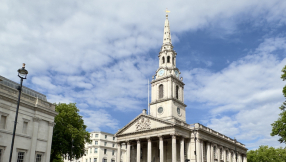
The London church that helped shape a nation: 300 years of St Martin-in-the-Fields
Few parish churches are as famous as St Martin-in-the-Fields in central London. This year, it marks its 300th anniversary. This is the story …
Pastor convicted of breaching abortion buffer zone set for appeal
The pastor delivered a sermon that made no mention of abortion.

Christian advent calendar sales 'soar' after online storm with Meghan Markle fans
The Leprosy Mission reports that sales of its Real Advent Calendar have “soared” following an online blow-up involving Meghan Markle and a pair of Anglican priests.
Immigration fears shape views of Britishness and Christianity, report finds
Concerns about immigration and cultural change extend beyond those most attached to Britain’s Christian identity, a new report by Theos has found.








