
Under new proposals being considered by David Blunkett, the UK Home Secretary, Britain’s ancient blasphemy and blasphemous libel laws may be repealed. The action is being pondered upon as part of a new system which will include a new offence: ‘incitement of religious hatred’. This is hoped to make clear to all that freedom of speech and the freedom of criticising religions is not curtailed.
It is thought, however, that a large number of evangelicals who back the fundamentals of ‘Christendom’, which maintains the churches’ position of power in society, are likely to be against the new moves. They will most likely see the news as a further secularisation.
The opposing view is held by more radical Christians who believe that the breakdown of Christendom will allow new opportunities for justice and peace-making to flourish. These groups are highly expected to back the new measures fully.
It was disclosed recently by Home Office officials that Mr Blunkett was mulling over the abolition of the blasphemy law during a meeting with the National Secular Society, whilst answering their concerns regarding the making of new incitement laws.
A spokesperson for the Home Office disclosed that it was an option under active consideration: “We are interested in whether the blasphemy laws should be retained, extended or amended in any form.”
Three years ago Mr Blunkett made clear that he favoured scrapping the common law offences of blasphemy and blasphemous libel.
“This particular provision has not been used for a very long time,” he told MPs on the Commons human rights committee in 2001. “It is my own view that there will come a time when it will be appropriate for the blasphemy law to find its place in history.”
It has been an argument used by some labour MP’s that the distinction is required as “blasphemy outrages people’s sensibilities, whereas incitement endangers their material and physical well-being.”
Secularists are highly concerned about a section of the 2001 emergency anti-terrorism legislation, and worried that it brings society closer to creating an “all religion” blasphemy law, and allows judges to impose a sentence of up to seven years if it is found that the offender has aggravated using motives of religious hatred. Keith Porteous Wood of the National Secular Society expressed his concerns that this legislation would have a negative impact on freedom of speech.
The Evangelical Alliance had reported its views that there is very little evidence for the need of such a law. They suggest that the “real threat to religious communities” comes not from other religions but from militant secularists.
The Home Secretary, Mr Blunkett, attempted to introduce the offence in the 2001 Emergency Anti-Terror legislation; however, it was opposed by the House of Lords, who felt it was an inappropriate measure in a bill dealing with terrorism.
There have been no public prosecutions for blasphemy since 1922.
No parliamentary time has so far been set aside for the planned incitement law but the home office has said it will be pursued at the earliest opportunity.



-

UN officials demand explanation for Iranian church seizure
-

AI could become a ‘very dangerous master’, warns John Lennox
-

Archbishop of Canterbury withdraws award given to Muslim cleric who praised Bin Laden
-

Calls for Church of England to be 'rooted in scripture' ahead of General Synod elections
-

Most practising Christians are evangelical, study finds
-
Church of England blessing same-sex relationships 'a bridge too far'
Most Popular
News
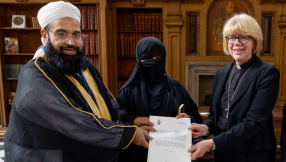
Archbishop of Canterbury withdraws award given to Muslim cleric who praised Bin Laden
Reform leader Nigel Farage said the decision to award Hafiz Muhammad Tahir Mehmood Ashrafi was "astonishing".
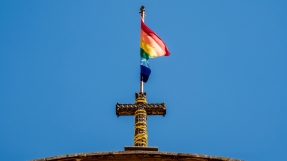
How the new General Synod could move beyond the present disagreement over same-sex relationships
How might the next Synod make progress in the next five years based on a recognition that there are those in the Church of England who hold fundamentally opposed positions on the matter? Is there a way of allowing both sides to achieve what they want? Martin Davie argues that the answer to this question is ‘Yes.’
No part of London should become a free speech, gospel exclusion zone
Soho is not exempt from freedom of speech and Christian expression. And Christians do not lose their fundamental freedoms when they cross an invisible boundary into a neighbourhood associated with a different worldview. The streets of London belong to all of us, writes Andrea Williams.
Church of England blessing same-sex relationships 'a bridge too far'
Earlier this year the Church silenced a group of former-homosexuals who wanted to tell of the change in their lives.








