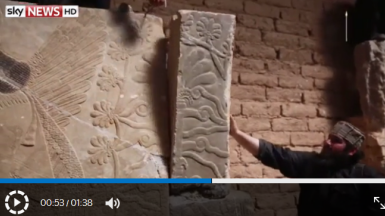
A video showing the total destruction of one of the most significant archaeological sites in the world by Islamic State militants has horrified archaeologists and historians.
The video released by the militants shows them using power tools and bulldozers to destroy monuments in the Assyrian city of Nimrud in northern Iraq. The site is then levelled using bulldozers.
Islamic State has previously destroyed other sites as well as manuscripts and other artefacts as it has declared them to be un-Islamic and therefore blasphemous.
The video shows men using angle grinders, sledgehammers and pneumatic drills to damage and dislodge stone friezes bearing the image of Assyrian deities. They can be seen rigging barrels filled with powder for explosion in a room lined with carved slabs.
The site is then ringed with explosives and the city is blown up, sending a mushroom cloud of dust into the air.
At the end of the video one of the militants says: "Whenever we are able in a piece of land to remove the signs of idolatry and spread monotheism, we will do it."
Another says: "God has honoured us in the state of Islam by removing and destroying everything that was held to be equal to him and worshipped without him."
Earlier reports said that Islamic State had burnt the library of Mosul, 20 miles south of Nimrud, to the ground, destroying around 8,000 early manuscripts.
Middle East expert Professor Fawaz Gerges, from the London School of Economics, told Sky News that Islamic State was a "social epidemic" that is "culturally cleansing" an area the size of the UK.
"(They have) been systematically destroying ancient relics and cultural artefacts both in Iraq and Syria," he said.
"They have a puritanical sense of an ideology that believes in cultural cleansing - not just people, but even art and culture. They want to purify the land - to establish a totalitarian ideology."
The United Nations has described the destruction of Nimrud and other sites as a 'war crime'. The director general of UNESCO, Irina Bokova, said when news of the destruction broke last month: "I condemn in the strongest possible manner the destruction of the archaeological site of Nimrud site in Iraq. This is yet another attack against the Iraqi people, reminding us that nothing is safe from the cultural cleansing under way in the country: it targets human lives, minorities, and is marked by the systematic destruction of humanity's ancient heritage."
Nimrud is thought to be the biblical city of Calah, mentioned in Genesis 10. It flourished between 1250 BC and 610 BC. It is famous for its 'lamassu' statues of winged bull and lions, some of which have been removed from the site.