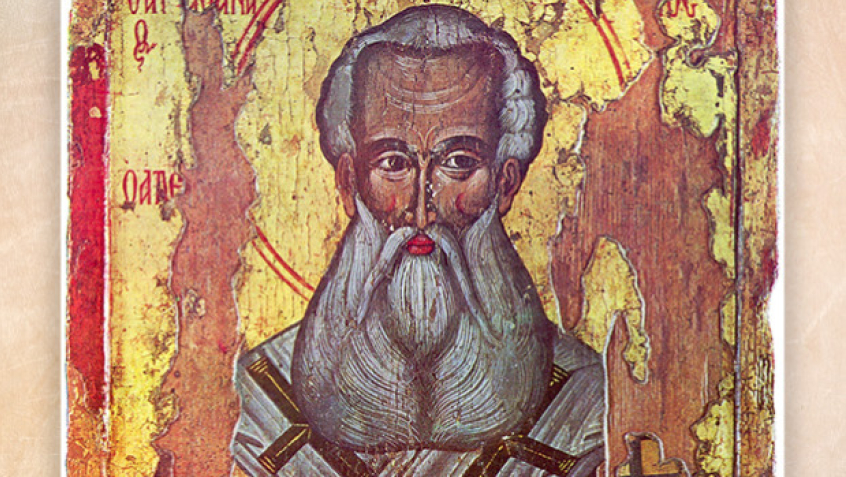
Today marks the feast day of a church father titanic in influence but perhaps unknown to many present-day Christians. Saint Athanasius of Alexandria faced down heresy and controversy in the earliest years of the church – decisively shaping orthodoxy as we now know it.
He was born between 296 and 298 in Alexandria, Egypt at a time when Christianity was still emerging, and 'orthodoxy' and the creeds by which we know it today were yet unformed.
Raised in a Christian family he gained an impressive secular education before later becoming an assistant to the Bishop of Alexandria at age 27, were he began the work that largely defined his career, in the historic First Council of Nicea in AD 325.
Behind that council, convened by the recently-converted Roman Emperor Constantine who sought to unite Christendom, was an ideological clash about the nature of Christ.
In 318 a Christian presbyter named Arius, from Antioch, had begun stirring up controversy, with popular writings questioning the idea that Christ was fully God. Understandably committed to monotheism and the supremacy of the Father, he posited that Christ was not pre-existent with God but was in fact created by God, and then through Christ the rest of the world was made. As Arius famously put it, 'there was a time when the Son was not'. It was a small shift but one with major theological implications – as evidenced by Nicea.
Athanasius became the chief adversary of Arius in this debate, arguing that if the Son had been created then he could not be worshipped as fully God, did not represent the true incarnation of God and could not truly save humanity from its sinful condition. These categories of identity were essential for the Gospel; as Athanasius put it: 'He became what we are so that he might make us what he is.'
The Athanasian side would ultimately win the contest: at Nicea the church declared Christ to be 'homoouisios' ('of the same substance') with the Father, and the famous line from the creed that Christ was 'begotten not made' comes from this very controversy.
But Athanasius' work was not finished at Nicea: Arian teaching continued to be popular, and after the death of Constantine, emperors less sympathetic to Athanasius had him exiled several times. Nonetheless, Athanasius maintained the position he'd stood for at Nicea, the stance that paved the way for a properly Trinitarian theology and came to be endorsed by all wings of orthodox Christianity today. For his contest with both Arians and emperors, he became known in Latin as 'Athanasius Contra Mundum': Athanasius against the world.
He's revered across denominations as a doctor, patriarch, 'pillar of the church' and 'father of orthodoxy'. Constantine had regarded the conflict at Nicea as one about what he called 'small and insignificant questions' – he really just wanted a united empire. But for Athanasius, the very identity of God and the hope of salvation was at stake.
Many laypersons today may not be familiar with this saint or the obscure fourth century philosophical clash that made his name. But – at a time when Christian confession about the real nature of Christ was still up in the air – this bishop held his ground, and shaped the creeds confessed by billions today.