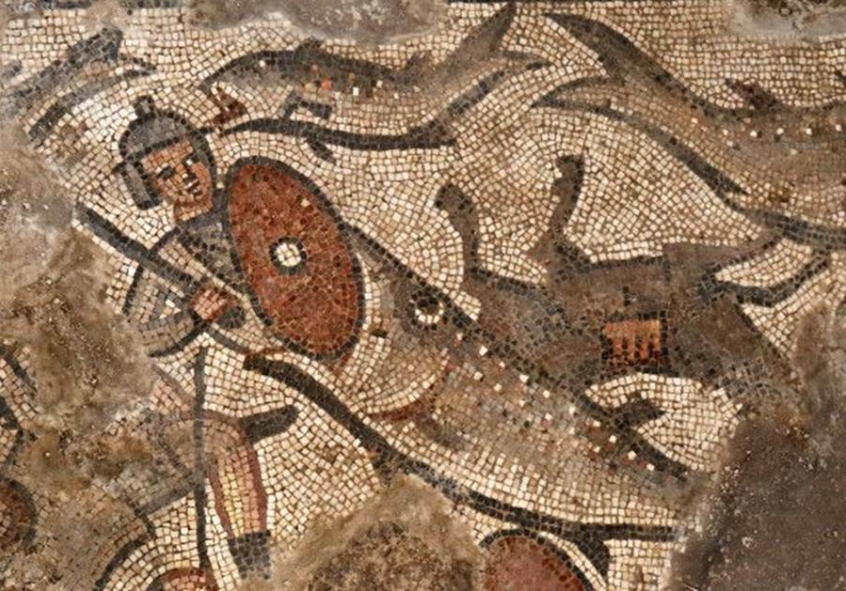
Archaeologists have discovered two panels of a mosaic floor of a Roman-era synagogue that depict Noah's Ark and the parting of the Red Sea during the exodus from Egypt at a synagogue in Huqoq, Israel.
"You can see the pharaoh's soldiers with their chariots and horses drowning and even being eaten by large fish," said excavation director Jodie Magness of the University of North Carolina, Chapel Hill, the National Geographic reports.
She said such images are very rare in this period.
"I know of only two other scenes of the parting of the Red Sea in ancient synagogues. One is in the wall paintings at Dura Europos [in Syria], which is a complete scene but different from ours—no fish devouring the Egyptian soldiers. The other is at Wadi Hamam [in Israel], but that's very fragmentary and poorly preserved," she said.
Magness said the ark scenes are uncommon and she knows of just two: one at the site of Jerash in Jordan, and the other at the site of Misis in Turkey.
Since 2012, Magness has been discovering mosaics at Huqoq. She returns to the site every June and excavates for one month with student volunteers and specialists in art history, soil analysis and mosaic conservation.
They recently found a series of unusual scenes in panels like an inscription in Hebrew surrounded by theatre masks, cupids and dancers; Samson and the foxes from Judges 15:4 in the Bible; Samson with the gate of Gaza on his shoulders from Judges 16:3; and a three-tiered mosaic that depicts the meeting of two important male figures.
One morning, a patch of mosaic was discovered showing a bear's hind leg with three long claws, and a leopard chasing a gazelle.
"As the dig worked eastward, a decorative ribbon known as a guilloche appeared. And then a couple of long-eared donkeys, two more bears with claws, two more leopards with spots, and pairs of lions, ostriches, humpbacked camels, little gray elephants, sheep, goats, slithering snakes—symbols of the whole menagerie, two of every living thing, that marched into Noah's ark before the great flood in the book of Genesis, chapters 6 to 9," the report said.
Magness said, "This panel is exactly as it should be. It's facing north, so people could see it as they entered from the south."
The team also uncovered the scene from Exodus 14:26—several fish, a horse floating upside down and soldiers bearing shields and spears who were swept off their feet by the Red Sea.