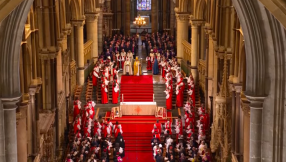
Last week, church leaders and politicians joined together in the ancient Westminster Hall for the Parliamentary Prayer Breakfast. From the outside, it could be seen as Westminster business as usual, a comfortable networking event for schmoozing in the heart of the establishment.
Yet I would argue that the breakfast is something radically countercultural – a space in the Houses of Parliament where we commit to praying for our leaders.
Throughout scripture, we are told to submit to authorities – to 'render to Caesar what is Caesar's', to 'submit ourselves for the Lord's sake to every human authority: whether to the emperor...or to governors'.
This doesn't absolve us from the requirement to speak out against injustice though. We are not called to be neutral over right and wrong.
But we are also given another command. To pray for those leaders. As Paul says in 1 Timothy 2: 1-2, 'I urge, then, first of all, that petitions, prayers, intercession and thanksgiving be made for all people – for kings and all those in authority, that we may live peaceful and quiet lives in all godliness and holiness.'
This is a command that some Christians might struggle with. 'Submit to and pray for politicians you say? Even the ones we don't agree with, or don't like?' Yes, absolutely. Remember that Paul wrote to Christians who were being persecuted by the same authorities for whom they were to lift petitions, prayers, and intercessions. At best, these authorities watched on, coolly detached, as mobs threatened to kill Christians. At worst, the authorities themselves took their families, their loved ones, their fellow worshippers and dear friends, torturing and killing them. Christians could expect to be humiliated and mistreated, thrown to wild animals in the Colosseum or burned as candles at Nero's dinner parties.
When we consider the context and culture of the time, suddenly, being asked to pray for those in authority looks a hard and daunting task. Maybe even an outrageous one.
And not only for the early church. Praying for political authorities is taken as a serious command by our persecuted brothers and sisters around the world today.
Wang Yi, a pastor in China, wrote this in a letter to his congregation not long before he was arrested in 2017: 'In 2004, I went to a large mountain on the border of Hubei and Chongqing to observe an underground house church there. At the 5 a.m. prayer meeting, elderly sisters who had rarely visited even the main town in their own county were in tears praying for China, for the leaders of China, and for Heilongjiang, Xinjiang, and Tibet. I was shocked. Prayer tied humble and difficult private life in a small mountain village to the well-being of a vast world.'
These elderly women in a remote rural house church, citizens with virtually no worldly influence on the governance of their nation, were simply exercising the only tool of political influence they had. What if we took this command to pray for our leaders nearly as seriously? As a friend said to me recently, 'if all you can do is pray, that's fine because even if you did have other options, it would still be the most powerful thing you could do'.
The problem is that praying for our leaders here in the UK can seem a little more, well, mundane. Does my local council really need me to pray for them to get the bins collected on time?
Maybe we should start with those leaders who we think deserve our prayers the least. Those who make us angry. Don't pray self righteous prayers, thanking God that you're not like them, but humbly lift them up to God. Ask that they may have compassion for the poor and the marginalised, for wisdom and not naivety, for more integrity and less spin, for humility and less boasting. Pray for their families, their home lives, that they might know Jesus. This isn't easy to do, but it's not meant to be.
The account of Jonah stands as a rebuke to me. Jonah was told to preach to the people of Nineveh, but he despised them and didn't think they deserved to be saved – so he ran away. Who is your Nineveh? Who is mine? Let's remember that we don't deserve to be saved either, nor do we deserve anyone to pray for us. Locate your Nineveh and pray for them today!
And let's thank God too for 180 MPs and Lords who were at the Prayer Breakfast last week to hear Amy Orr Ewing's amazing talk on forgiveness. Many of those politicians will not be Christians, so let's pray that the seed of God's word will have been planted firmly in their hearts and that He will bring it to fruition.
Tim Farron has been the Member of Parliament for Westmorland and Lonsdale since 2005, and served as the Leader of the Liberal Democrat Party from 2015 to 2017.Tim is also the host of Premier's 'A Mucky Business' podcast. His new book A Mucky Business: Why Christians should get involved in politics is published in November.