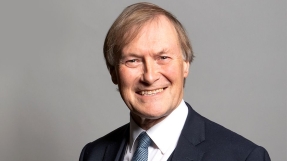
As the tributes to and comments about Martin McGuiness testify today, the former IRA chief of staff who became a key figure in the Northern Ireland peace process is as divisive in death as he was in life.
Hailed as a 'great guy' by Alastair Campbell, a 'peacemaker' by Tony Blair and a man of 'humility' by Gerry Adams, he was dismissed as 'a coward who never atoned for his crimes' by the former Conservative chairman Lord Tebbit, whose wife Margaret was paralysed when the IRA bombed a Brighton hotel during the Conservative Party conference. McGuinness was, after all, a key figure in both the Troubles and the peace that followed.
But one area of his life that is not in doubt, was his faith. 'I believe in Jesus Christ,' he once told me. 'There are many others throughout the world who don't believe in Jesus Christ, but this is what I believe. I respect what they believe, and all I ask is that they respect what I believe.'
His approach to religion was surprisingly liberal. 'I'm an Irish Catholic, I believe in Catholicism, but I'm a very broad-minded Irish Catholic,' he added. 'And since the peace process began, I have made very close friendships in the Presbyterian Church, and the Church of Ireland, and the Methodist Church. And some of my strongest friends are in those churches. Recently I was invited to the installation of a new minister in Christ Church in Derry. I was invited to that and I went along and sat quite happily in the congregation as my friend was installed in that church.'
Asked how his faith affected his politics, McGuinness said: 'It doesn't affect my politics at all. I understand that, in the context of being in a very important governmental position, there will be people in society who are not Christians, and there will be people in society who believe in other things, and there will be people who believe in nothing. And I have a responsibility to everybody. We have to govern by treating every single citizen equally, and so that they, too, understand that they'll be treated equally.'
The answer was typical of a man whose life and character reflected the complexity of the situation in Northern Ireland itself.
As Peter Lynas, Northern Ireland director of the Evangelical Alliance, has said: 'He was a complex character who significantly shaped Northern Ireland as both a senior figure in the IRA and as a politician.'
Born on 23 May 1950 in the Bogside area of Derry, McGuinness was the second of seven children of religious parents, William, a foundry-worker, and his wife, Peggy (nee Doherty).
Though he came from a religious background, McGuinness did not come from a republican one, unlike Gerry Adams. But grew up in a city where gerrymandering meant that Protestants always controlled the city council, despite Catholics being the majority population.
The young McGuinness failed his 11 plus (an exam he would later scrap as education minister in the region), and on leaving the Christian Brothers' technical college he was turned down for a job as a car mechanic because he was a Catholic. He became a butcher's assistant, a role that was mockingly cited during the Troubles.
He was still a teenager when he was drawn towards violence in Derry.He was shocked into activism by pictures in 1968 of Gerry Fitt, the Catholic MP for West Belfast, covered in blood after being hit by police batons as he led a civil rights march.
Within months McGuinness was second in command of the IRA Derry Brigade, the position he still held on 30 January 1972 - Bloody Sunday - when British parachute regiment soldiers shot dead 13 unarmed Catholic demonstrators.
One of the most difficult questions I've put to anyone was to ask McGuinness if he has ever killed a man. He did not answer directly, but he did strike an apparently remorseful note when he said 'I accept all the responsibilities that are due to me'. He replied: 'I made my statement to the Bloody Sunday tribunal, where I admitted that I was a member of the IRA in Derry during a very difficult period of our history. And that's what I want to say about it. I remember, for example, I was arrested, I think in 1974, and one of the British tabloids ran a headline claiming that I had boasted that I had killed six British soldiers. I had never done anything of the sort; it was a total and absolute lie. But as a former member of the IRA, I accept all the responsibilities that are due to me. I was a member of the IRA at that time and the IRA were involved in a bitter conflict against the British army and the forces of the state. But in terms of the individual circumstances, I don't comment on that.'
McGuinness was arguably redeemed by his key role as the Deputy First Minister of Northern Ireland from May 2007 to January 2017. Forging an unlikely working relationship and, later, friendship with Ian Paisley of the Ulster Unionists, McGuinness played a key role in the Good Friday Agreement convened by Blair in 2008.
He served as MP for Mid Ulster from 1997 to 2013, abstaining from all votes in the House of Commons, as is standard practice for Sinn Fein MPs.
McGuinness is survived by his wife Bernadette and their children and grandchildren.