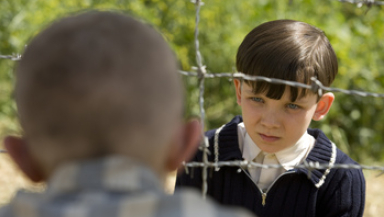
|PIC1|One of the most moving films of the year, The Boy in the Striped Pyjamas is a powerful, haunting story about the horrors of the Holocaust.
Unlike the vast majority of such stories, however, it doesn't allow the audience to view events through the eyes of a Jewish character. Instead, we see things from a German perspective. But this is not a revisionist telling of the story, let alone a justification of the Final Solution, but a fresh look at it through the innocent eyes of eight-year-old Bruno (Asa Butterfield).
I asked John Boyne, who wrote the novel on which the film is based, why he had taken this route since it ran the risk of making us feel more sorry for the oppressors than the oppressed. He replied that he felt compelled to write about this subject, keeping the memory of it alive for a new generation, yet could not presume to tell the story through the eyes of a Jewish inmate. Instead, by looking in through the fence from outside, he could ask the important questions.
He says, "For me, a 34-year-old Irish writer, it seemed that the only respectful way to approach the subject was through innocence, with a fable told from the point of view of a rather naive child who couldn't possibly understand the horrors of what he was caught up in. I believe that this naiveté is as close as someone of my generation can get to the dreadfulness of that period."
The film opens in Berlin with Bruno and his friends pretending to be fighter planes as they run home to his house. This is a simple, but effective device for drawing us into Bruno's world. He is a young boy playing as all young boys do, when they have the chance, during wartime: they imagine themselves as heroes fighting the enemy.
At the same time as British boys were imitating Spitfires during the Second World War, German boys were pretending to be Messerschmitt 109s - and both were possessed of the simple, unwavering conviction common to all children that their side was right.
It's entirely natural that Bruno worships his officer father Ralph (David Thewlis). As viewers we immediately see him within the framework of what we know of World War II. But to his son, he is a hero and a good man, and certainly the film suggests that he has been a loving husband and father as well as a good soldier. He is portrayed as someone who does what he thinks is right for his country and a party is being held to celebrate his promotion.
We don't know what this entails for some time, though we see from his uniform that he is an Obersturmbannfuehrer (equivalent to a Lieutenant-Colonel) in the SS, the part of the German forces that were unswervingly loyal to Hitler, earning him the disapproval of his mother.
Ralph's new posting is in Poland - as commandant of a death camp. From his bedroom window in their new, and imposingly severe, house, Bruno sees what he assumes is a farm. At first he thinks there will be new friends for him there, but he's puzzled by how strange they look, all wearing striped pyjamas. As the days pass, he becomes increasingly bored, but he is banned from exploring the garden at the back of the house.
One day, he asks his father's driver, Obersturmführer Kotler (Rupert Friend), for a tyre to make a swing. Kotler shouts at Pavel (David Hayman), a prisoner who works at the house, to take the boy to find one. When Pavel takes him to the shed in the back garden, Bruno spots a route through the window into the woods beyond the house. It's not long before he grabs a chance to sneak through and he goes exploring.
Inevitably he reaches the camp fence where he first meets Schmuel (Jack Scanlon), a Jewish boy of the same age. It is in their encounters that we see Bruno's naiveté most clearly, because we know all too well what is going on inside. He's envious at first - an emotion that is touchingly amusing as well as startling to the viewer because it is so inappropriate:
Bruno: It's not fair, me being stuck over here all on my own while you're in there playing with friends all day.
Schmuel: Play?
Bruno: Well, isn't it part of a game - with your number?
Schmuel: It's just my number
On another occasion, Bruno suggests that Schmuel could come for supper. He's surprised that the wire prevents this; surely farm fences are to stop animals getting out. And he's troubled when Schmuel tells him that it's to stop the people getting out. 'Why, what have you done?' he asks. 'I'm a Jew,' is the simple answer.
Bruno has been brought up to believe Jews are evil, but now he begins to struggle with the disparity between what he has learnt and what he is now experiencing first hand. He asks his tutor, 'There is such a thing as a nice Jew, isn't there?' 'If you ever found such a thing as a nice Jew,' he's told, 'you would be the greatest explorer in the world.'
This tis the problem at the heart of The Boy in the Striped Pyjamas. How could such an enormous evil take place in a supposedly civilised society? How could ordinary people become swept up in it, to the extent of hating Jews (and Gypsies along with other 'deviant' groups), condoning their extermination and even participating in it? And how are we to think about such people?
Part of the answer, as this film makes clear, is that most people were ignorant of the full extent of what was happening. Young Bruno is naturally protected from knowing much of what the war entails. But it's not only Bruno who is ignorant. Some time after the family has moved, we discover that Bruno's mother, Elsa (Vera Farmiga), does not know what happens in her husband's camp. One day she returns from a trip into town and comments to Kotler about the foul smell from the camp chimney. When he replies that 'they smell even worse when they burn,' the realisation finally dawns.
She confronts Ralph who insists that he was sworn to secrecy, but he is clearly not going to be dissuaded from his task. From that moment, Elsa's trust, respect and love for her husband evaporate. This is entirely true to history. Officers were banned from telling even their immediate family about the gas chambers; they were to be seen as 'normal' concentration camps, where the primary objective was forced labour, not extermination. Even Hedwig Hoess, the wife of Rudolf Hoess the commandant of Auschwitz, didn't realise for around two years what was happening, and she lived close to the crematorium with her four children. She only discovered after overhearing a conversation at a party.
Another part of the answer to how such a thing could happen was famously expressed by Hannah Arendt as 'the banality of evil'. By this she meant that evil is not something radical, but arises out of the tendency of ordinary people to follow orders, to accept what they're told by authorities, to conform to the prevailing opinion. Just how easily this happens, even in a liberal democracy like America, was demonstrated in an infamous experiment carried out in a Californian high school by a teacher there. When his class were thoroughly apathetic about fascism, he persuaded the students to order themselves in a fascist way and was shocked by how quickly they conformed and how fast it spread through the school. It forms the basis for the German film The Wave (Dennis Gansel, 2008).
The worrying reality - and one reason why it's vital to keep the memory of the Holocaust alive - is that people easily fall into line without ever stopping to reflect critically on what they are doing, the underlying values or the results of their actions. Or their inaction.
This is where Elsa herself is implicated, because she failed to face up to what she did know was happening. The Final Solution of mass killings may have been kept from her, but like all ordinary Germans, she was very well aware of the round-ups, the mass deportations to the labour camps. It is likely that she would be aware of executions in the streets. And as for the camp run by her husband, she knew full well that prisoners were treated in an inhuman way because it happened in her own house. She never questioned the idea that these people were evil, the cause of all Germany's problems and a danger to all good people. She was prepared to accept her husband telling Bruno that 'they're not real people'.
Vera Farmiga says of her character, "Elsa doesn't think. She doesn't think for herself, she doesn't think deeply. She chooses to be oblivious, concerning herself only with the safety of her family and her position in society - everything else is beyond her periphery.
"She's a sort of accomplice and assistant to her husband's ideals, his desires, his morals and his ambitions. But as she starts to open her eyes to what is unfolding, as she starts to explore for herself, there is a gradual decline of tenderness, trust and respect for her husband. And eventually she stands up and says No!
"Eventually, she condemns what's going on. She even tries to get her husband to see the evil that he's responsible for. But it's too late . . . She has intuitions; she knows that people are being horribly mistreated. But she doesn't look; she doesn't want to see it because seeing it would implicate her husband, and it would implicate herself."
As Bruno's understanding of the camp begins to grow, he is naturally increasingly troubled by the conflict within him, because he still loves his father. He questions his sister Gretel (Amber Beattie) about the place he longs to believe is just an odd farm. Gretel insists that the Jews are 'in there because they're evil. Evil, dangerous vermin.' 'Papa's not horrible is he?' asks Bruno. Gretel assures him that their father is a good man. 'But he's in charge of a horrible place,' Bruno replies.
This disjunction between family man and camp commandant is very troubling for the viewer. It's easy to think of such people as sadistic monsters like Amon Goeth (Ralph Fiennes in Schindler's List). But for the first part of the film, it's hard not to like Bruno's father. This is partly because David Thewlis plays him so warmly, emphasising this true-to-life complexity.
He says, "The challenge is not to play a clichéd, two-dimensional evil Nazi. In my research, I came to learn that my character was very much based on fact. . . . I don't think I've researched a film as much as this for years because I felt a great duty to do that.
"Usually, I take someone from my own life, someone I've met at some point and think, that person could have been like this person. How can I apply those characteristics? Whereas I've never met anyone who at all resembles the character I'm playing here because it's quite unimaginable to understand how one could be a loving father - I'm sure he is a loving father - and at the same time, leave your children at breakfast, go next door - literally - and spend your day amidst these terrible, terrible, terrible atrocities. How do you get your mind set into that?
"I was given a letter that Rudolf Hoess [commandant of Auschwitz] wrote to his children just before his execution. It was lying around at home, on my kitchen table, and I had some neighbours over. I hadn't told them what I was working on. They saw this letter lying around and started reading and when they'd finished it, they turned to me and said, 'Oh, what a beautiful, heart-rending letter this man has written to his children! Who was he? Why was he dying? Was he sick?' To which I replied, 'Yeah, he was VERY sick!' But the letter is clearly written by a man with an intense love for his children; it's very articulate, very touching, almost poetic.
"Try and understand a human being - a sensitive human being - but one who's capable of this! No way can I find it in myself to justify or forgive, obviously. But my job was to somehow find the humanity in him, and not to see all these people - as the cliché goes - just as monsters. They were human beings. And there are people out there today that are just like him."
This is why films like this are so important. We must never forget what horrendous evil Hitler unleashed. Neither must we forget that it was ordinary people who became caught up in his genocide machine.
The power of his rhetoric and personality, coming at just the opportune time in German history, won the nation to his cause. Ordinary people became mass murderers. Ordinary people looked the other way while it happened. It was easier to believe the propaganda, to go with the flow and keep quiet than to stand up and face the consequences.
It is, of course, easy to understand why people were afraid to voice opposition when to do so could lead to a labour camp. Dachau was, after all, established as early as 1933 for political prisoners. We do not know how we would have acted if we had been there. Nevertheless, we must say that, fear does not excuse inaction. 'Following orders' does not excuse evil.
These things happen in our own generation: Cambodia, Rwanda, Srebrenica, Darfur, East Timor. Ordinary people still allow themselves to be swept along by evil men, not thinking, not questioning and not challenging what is happening. Given the easy-come, easy-go morality of contemporary western society, this is terrifying.
While it is traumatic, The Boy in the Striped Pyjamas is also a story of hope. Bruno's innocent acceptance of Schmuel as a human being, just like him, who deserves his friendship, compassion and help, is absolutely right. While everyone else fails to looks beyond their prejudices, Bruno reaches out to the boy he is told should be his enemy. He identifies with Schmuel, recognising that they are no different. He comes to understand that Pavel is a good man, not potato-peeling vermin. This refusal to accept distinctions between human beings as equal is vital. It is fundamental to civil society. It is fundamental to how we are created by God.
The moral relativism of contemporary society has no basis on which to establish this equality. Yes, it makes the right kind of noises, saying that everyone is entitled to their own beliefs and values, which should be respected. But why? There's nothing objective about it; it is too vulnerable to the whims of the few, who are able to carry others along with them. The only answer is the deeply held, thought-through principles of an objective morality. Ultimately, any objective morality must come from beyond mere human beings; it must come from God.
It is not enough that society should be based on Christian values. That had been true of Germany, after all. Rather, the individuals within society need to become convinced of them and committed to their outworking personally. The values of Jesus Christ - his concern for truth and righteousness, his compassion for the weak and lost, his acceptance of every kind of person (among others) - need to permeate our own lives before they can permeate society.
The Boy in the Striped Pyjamas, with its anguishing loss of innocence and its touching affirmation of the value of all people, has the power to engage us, overwhelmed us and change us.
This article was first published on Damaris' Culturewatch website (www.culturewatch.org) - used with permission.
© Copyright Tony Watkins (2008)